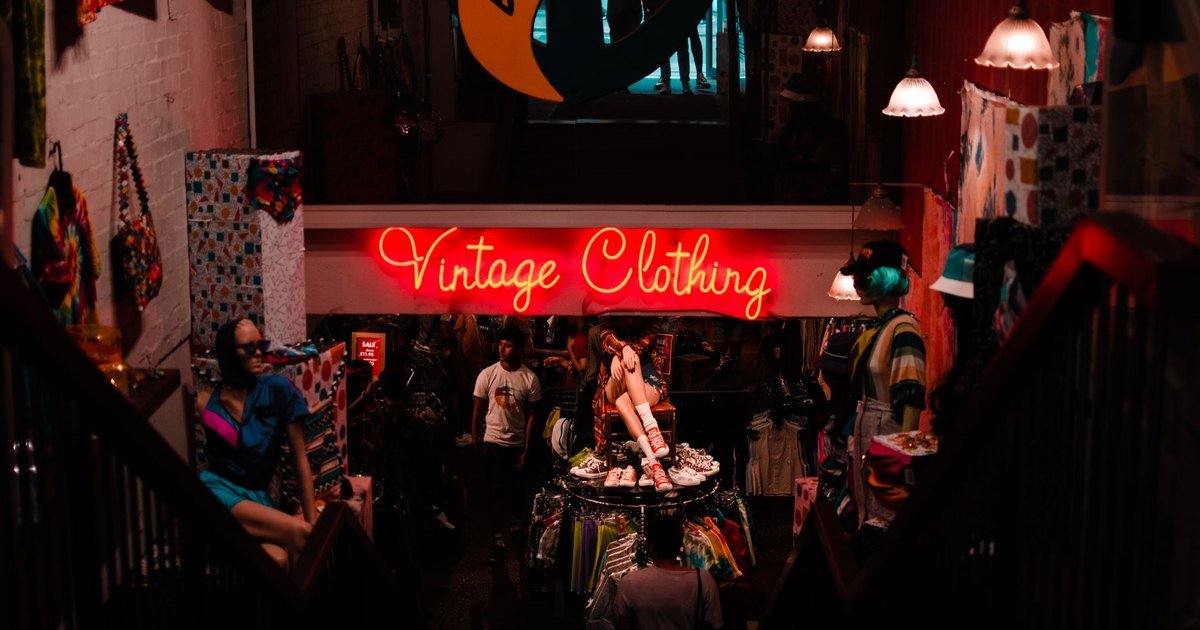

A vintage clothing store sells garments that are genuinely old — the working trade definition is at least 20 years — rather than new clothes cut to look old. As of July 2026, expect to pay roughly $25–$60 for an ordinary 1990s piece online, $45–$120 for vintage Levi’s 501s, $60–$300 for an original single-stitch band tee, and $90–$350 for a 1970s leather jacket. If you are on the other side of the counter, the maths inverts: a vintage store that buys outright typically pays 20–40% of what it expects to sell your item for, and a consignment boutique keeps 40–60% of the final price.
That gap between what a store pays you and what it charges the next person is the single most useful thing to understand about the vintage trade — it explains shop pricing, it explains why the same jacket costs $40 in one place and $180 in another, and it decides whether you should sell to a store at all. This guide covers both directions: how to buy real vintage online without overpaying, and how to sell the vintage sitting in your wardrobe while keeping the whole price.
- Vintage means 20+ years old. Antique means 100+. “Retro” and “vintage-inspired” mean new clothing made to look old — different product, different price.
- Five label checks date almost any garment in under a minute: care label, union label, single-stitch hem, RN number and zip hardware.
- Vintage sizing is not modern sizing. A 1960s size 12 is roughly a modern US 6. Buy on measurements, never on the number sewn into the collar.
- Selling to a store costs you 60–80% of the value. Buy-outright pays 20–40%, consignment keeps 40–60%, fee-charging marketplaces take 10–20%.
- The tag photo is the trust shot. Vintage listings with a clear close-up of the label sell faster than listings with better styling and no label.
What counts as a vintage clothing store?
“Vintage clothing store” covers five quite different businesses, and knowing which one you are dealing with tells you in advance whether the price is negotiable, whether the sizing will be accurate, and what the shop will pay if you bring items in.
| Type of shop | What it stocks | How stock is priced | What it pays sellers |
|---|---|---|---|
| Vintage boutique | Curated, dated pieces — usually 1950s–1990s, often specialising in one decade or category | By rarity and condition; owner researches comparable sales | 20–40% of expected resale, cash, on the spot |
| Buy-sell-trade store | Recent secondhand plus 1990s–2000s vintage; fast-moving, trend-led | Flat percentage of estimated retail | Around 25% cash or 50% store credit of their selling price |
| Charity or thrift shop | Whatever is donated — unsorted by era, vintage appears by accident | Flat rates by garment type, rarely by value | Nothing — stock is donated |
| Consignment boutique | Higher-value pieces the shop does not own until they sell | Shop sets the price; markdown schedule after 30–60 days | 40–60% of the sale price, paid after it sells |
| Online vintage marketplace | Independent sellers’ own stock, searchable by decade, brand and measurement | Each seller prices their own items | Whatever the seller sets, minus that platform’s fees |
The first four all involve a middleman who has to make a margin. The fifth does not, which is why an identical 1990s Carhartt jacket can be $55 from a private seller and $160 in a curated boutique — you are paying the boutique for the sourcing, the steaming, the repair and the shop rent. Sometimes that is worth it. For a guide to how the wider secondhand landscape fits together, see what thrifting actually means, and for the selling side specifically, how consignment works and what it costs.
Vintage, retro, antique or secondhand — the words are not interchangeable
Sellers lose money by mislabelling and buyers overpay by not asking. The trade uses these terms precisely:
| Term | What it actually means | Why it matters to the price |
|---|---|---|
| Vintage | Made roughly 20–99 years ago — in 2026 that is anything up to about 2006 | Age plus scarcity supports the premium |
| Antique | 100+ years old — Edwardian and earlier | Fragile, collector market, rarely wearable daily |
| Retro / vintage-inspired | Brand new clothing cut in an old style | No age value at all; worth its retail discount, nothing more |
| Deadstock (NOS) | Genuinely old but never worn or sold — old shop stock | Commands 30–100% over the worn equivalent |
| Reproduction / reprint | A modern copy of a specific old design, often licensed | Worth a fraction of the original — the classic band-tee trap |
| Preloved / secondhand | Previously owned, any age at all | Priced on condition and brand, not on era |
The distinction that costs people the most money is the last-but-one. A licensed reprint of a 1994 tour tee looks close to the original on a phone screen and sells for a tenth of the price — our guide to telling an original band tee from a reprint walks through the tells in order.
How much does vintage clothing cost in 2026?
These are typical asking prices in the online vintage market as of July 2026, for pieces in genuinely wearable condition. Boutique retail sits at the top of each band or above it; private-seller prices sit at the bottom.
| Piece | Era | Typical online price | What pushes it to the top of the band |
|---|---|---|---|
| Levi’s 501 jeans | 1980s–1990s | $45–$120 | Made in USA, redline selvedge, big-E tab, dark unwashed denim |
| Denim jacket (Type III) | 1970s–1990s | $50–$150 | Blanket or sherpa lining, USA-made, no repairs |
| Band tee, original | 1980s–1990s | $60–$300+ | Single stitch, tour dates on the back, cult act, soft fade |
| Leather jacket | 1970s–1980s | $90–$350 | Talon zip, heavy hide, supple lining, no cracking |
| Workwear jacket (Carhartt, Dickies) | 1980s–1990s | $60–$180 | Union-made tag, honest fade, blanket lining |
| Silk or rayon day dress | 1960s–1970s | $45–$140 | Original belt, unbroken metal zip, no underarm damage |
| Cashmere or lambswool knit | 1970s–1990s | $25–$80 | Two-ply or better, Scottish or Italian make, no moth holes |
| Y2K slip dress, mesh, low-rise denim | 1998–2006 | $25–$70 | Recognisable label, on-trend colourway, small sizes |
| Designer runway piece | 1980s–2000s | $150–$1,200+ | Documented season, intact labels, archival demand |
Category deep-dives with model-by-model pricing live in our thrifting guides: vintage Levi’s 501s, vintage denim jackets, vintage band tees, vintage Polo Ralph Lauren and the Y2K fashion guide. If you are trying to work out which labels hold value at all, start with the vintage brands worth looking for.
How to spot real vintage in 60 seconds
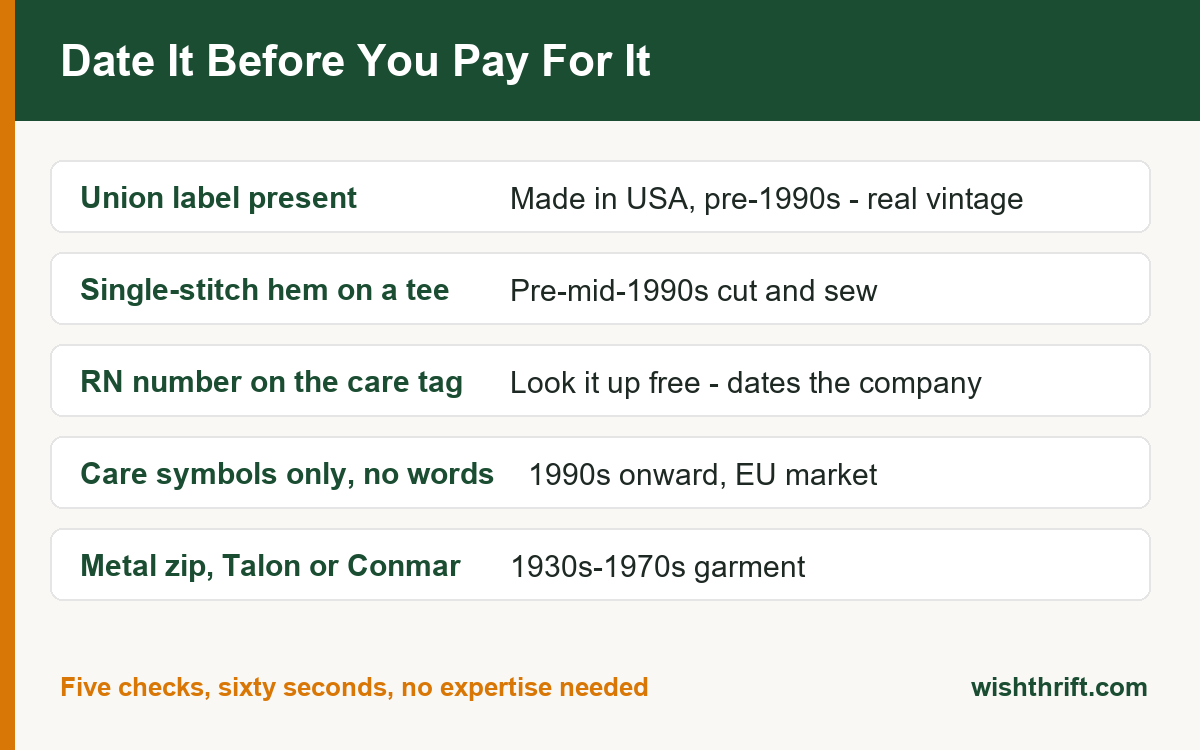
You do not need expertise to date a garment — you need to look inside the collar and at the seams. Five checks, in the order they are quickest to do:
1. Is there a care label at all? US law has required care labelling since 1971. A garment with no care instructions anywhere, only a brand tag, is very often pre-1972. Later garments went the other way: care instructions given purely as symbols with no words point to the 1990s onward, particularly for the European market.
2. Is there a union label? An ILGWU or ACWA label means the piece was made in a unionised US factory. The ILGWU merged away in 1995, so a union tag reliably puts the garment before the mid-1990s — and confirms US manufacture, which is itself a value signal on workwear and denim.
3. Single or double stitch at the hems? Turn a t-shirt sleeve inside out. A single line of stitching at the sleeve and bottom hem is typical of tees made before the mid-1990s; the doubled line replaced it as production sped up. This is the fastest single check on any tee.
4. Is there an RN number? US-sold garments carry a Registered Identification Number issued by the FTC. It identifies the company, and because the numbers were issued sequentially from 1959 onward, a low number means an older registration. It is free to look up and it is the check that catches most fakes — see our RN number lookup guide for how to read the result.
5. What is the zip made of, and who made it? A heavy metal zip branded Talon, Conmar or Scovill points to a mid-century garment; nylon coil zips took over through the 1970s. A side zip on a dress is another strong pre-1970s signal.
Two of these agreeing is usually enough. If the label story and the construction disagree — a modern care symbol on a supposedly 1970s dress — trust the construction and ask the seller before you buy.
Why vintage sizing runs small, and how to buy without returns
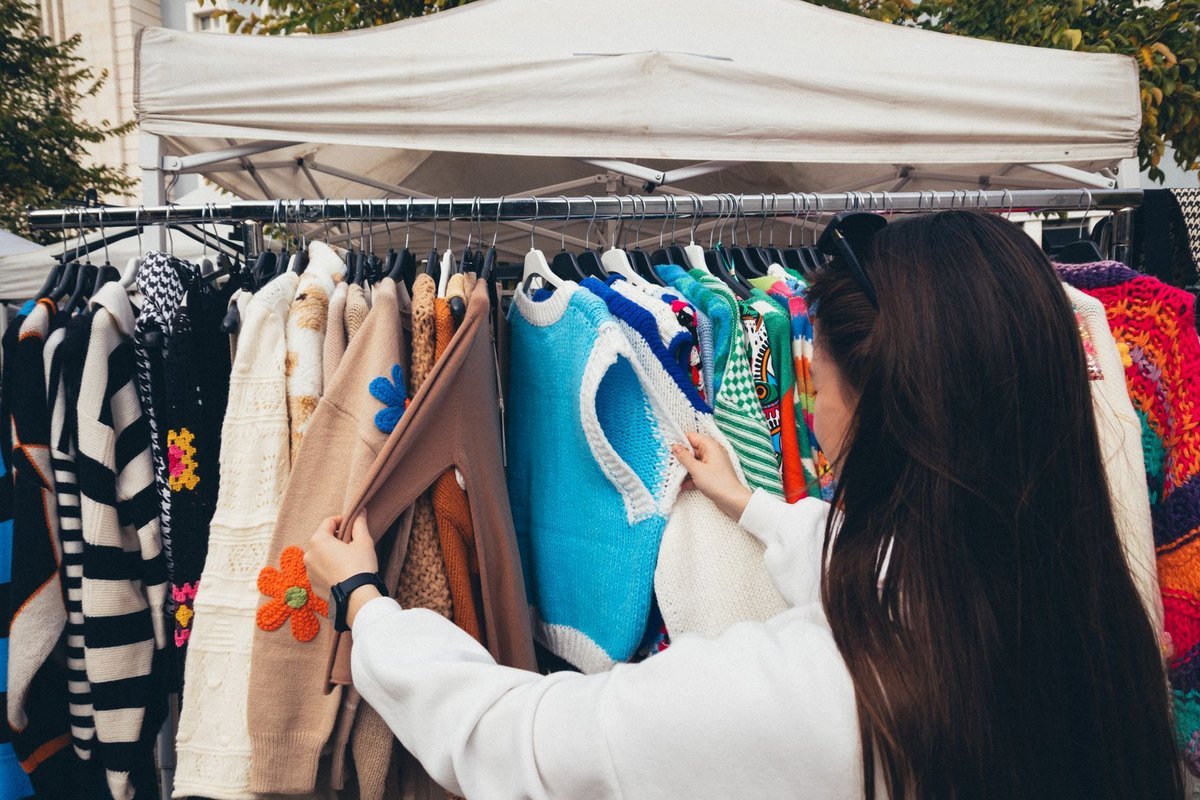
Size labels have drifted for sixty years. A garment labelled size 12 in the early 1960s corresponds to roughly a modern US 6; a 1980s size 10 is closer to a modern 6–8. Menswear drifted less, but vintage trousers were cut for a higher waist and vintage shirts for a narrower shoulder. The label number tells you almost nothing useful, which is why every competent vintage seller lists measurements instead.
| Garment | Measurements that decide the fit | Ask for these if they are missing |
|---|---|---|
| Tops, tees, knitwear | Pit-to-pit, shoulder seam to shoulder seam, total length | Sleeve length from shoulder seam |
| Jackets and coats | Pit-to-pit, shoulder, length from collar seam, sleeve | Whether it was measured flat and buttoned |
| Jeans and trousers | Waist flat (double it), rise, inseam, leg opening | Whether the waistband has stretch or is rigid denim |
| Dresses and skirts | Bust, waist, hip flat, total length | Whether the zip is original and runs freely |
Compare those numbers to a garment you already own and like, laid flat on a table. That one habit eliminates most vintage buying disappointment — and for a seller, publishing them is the cheapest way to stop returns and questions before they happen.
Shopping online versus a vintage store near you
Neither wins outright, and it is worth being straight about that. A physical vintage store lets you try things on, judge drape and smell in person, and walk out with the item — decisive advantages when sizing is unreliable and every piece is one-of-one. What a local shop cannot do is hold every decade in your size at once. Its stock is whatever came through its door that month, and the rent is in the price.
Online, you are searching rather than browsing: you can filter to your exact measurements, compare five sellers on the same 1990s jacket, and buy from another country. The trade-off is that you are buying on photographs, so the label checks above and the measurement list do the work your hands would normally do.
A sensible pattern is to use local shops for anything structured you need to try on — tailoring, coats, boots — and buy online for pieces where measurements settle it, which is most tees, knitwear, denim and outerwear. On WishThrift you can browse preloved clothing across women’s and men’s listings, message the seller directly with a measurement question before you commit, and buy from sellers in the UK, US, India and Canada. For the wider landscape of where else to look, see the best online thrift stores and our country-by-country guide to buying secondhand.
Selling to a vintage store versus selling it yourself
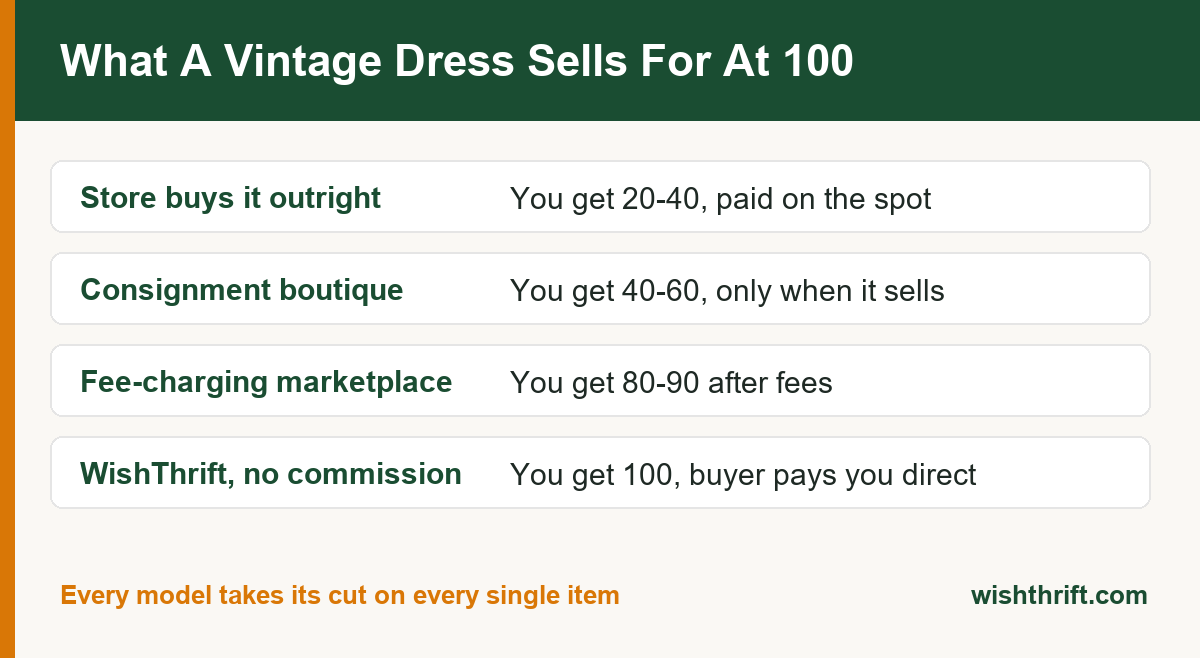
This is where the money actually is. Say you have a 1970s wool coat that a shop would retail at $200. Here is what each route returns to you:
| Route | You receive | When you get paid | Effort |
|---|---|---|---|
| Vintage store buys it outright | $40–$80 | Immediately, in cash | Lowest — one trip, no photos |
| Buy-sell-trade chain | ~$50 cash or ~$100 store credit | Immediately | Lowest, but credit locks you in |
| Consignment boutique | $80–$120 | Only when it sells, often 30–90 days | Low, but you lose price control |
| Marketplace charging seller fees | $160–$180 | On sale, minus 10–20% in fees | You photograph and list it |
| Selling direct on WishThrift | $200 | On sale, buyer pays you directly | You photograph and list it |
On one coat the difference between the top and bottom row is $120–$160. On a wardrobe clear-out of fifteen pieces it is the price of a holiday. The middleman is buying your convenience, and for a single low-value item that trade can be perfectly rational — but the cut is charged on every item, every time, which is exactly the compounding that the consignment maths makes concrete. If you have a quantity of genuine vintage to move, our dedicated guide to selling vintage clothes online compares the platforms, and the WishThrift seller hub covers how listing here works.
How to list vintage so it actually sells
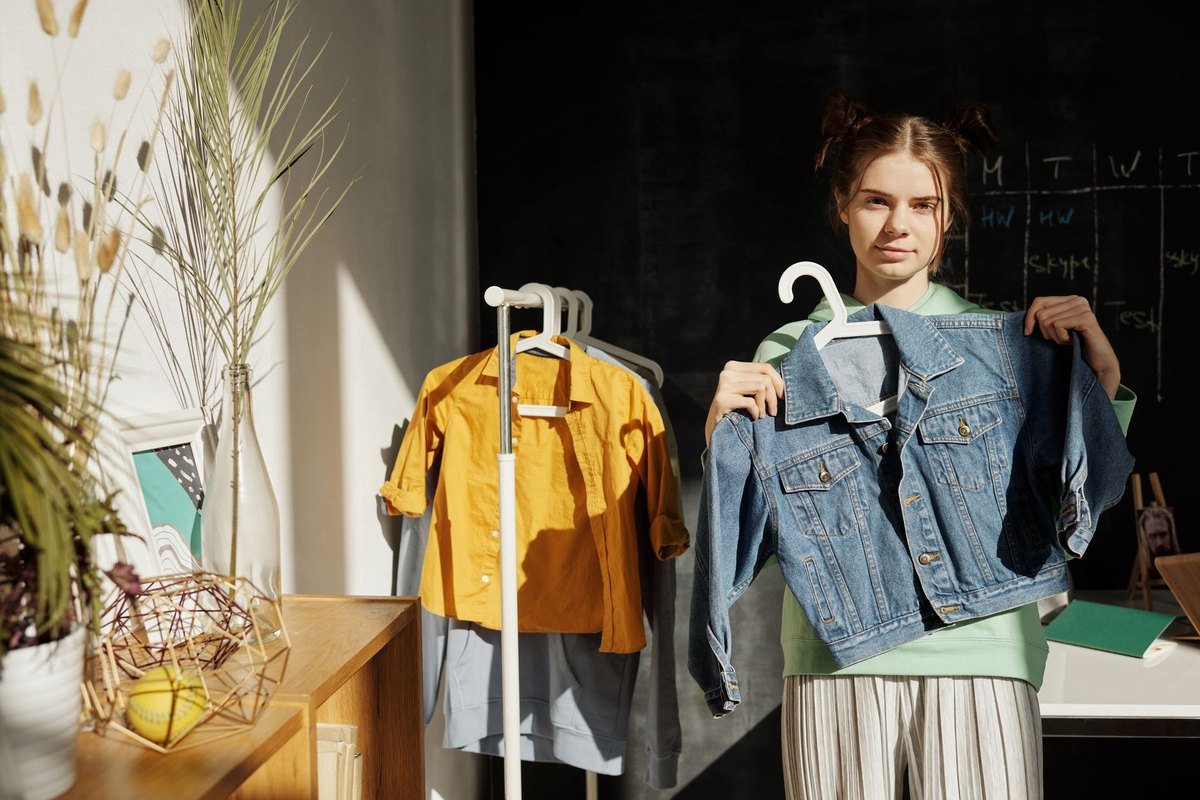
Vintage buyers are unusually specific. They arrive searching a decade, a brand, a cut or a measurement, and they buy from whoever answers their question first. Five things do most of the work:
Shoot in this order. Full front, hung flat against a plain wall in daylight; full back; a close-up of the brand and care labels; a tape measure laid across the chest; a close-up of every flaw; and one worn or styled shot last. The label close-up is not optional — it is the photograph that convinces a stranger the piece is genuine.
Write the title the way a buyer searches. The pattern that works is decade + brand + garment + colour or pattern + size with measurement. So “90s Levi’s 501 Straight Jeans Dark Wash W32 L34” rather than “cool retro jeans”. Buyers type decades and measurements; they do not type adjectives.
| Weak title | Title that gets found |
|---|---|
| Vintage denim jacket, lovely condition | 80s Levi’s Type III Trucker Jacket Light Wash M — 21″ pit-to-pit |
| Retro band t-shirt | 90s Single Stitch Metallica Tour Tee Black L — original, not a reprint |
| Old wool coat, very warm | 70s Camel Wool Overcoat Made in England UK 12 — full length, original buttons |
Publish the measurements in the description, not just the size. Pit-to-pit, shoulder, length and sleeve for a top; waist flat, rise, inseam and leg opening for trousers. It removes the single most common pre-purchase question.
State the flaws plainly. Fading, a repaired seam, a replaced button, a faint mark under the arm — vintage buyers expect honest wear and will accept it, but an undisclosed flaw turns a sale into a dispute. Describe it and photograph it.
Price against comparable sold items, not retail. The ordinary secondhand rule of thumb — a quarter to 40% of original retail — does not apply to vintage, where scarcity, not depreciation, sets the price. Search the exact piece, look at what has actually sold rather than what is listed hopefully, and price in the middle of that band unless your condition is exceptional. Anything genuinely rare should be listed at the top and left to sit.
Five mistakes that cost real money
Paying vintage prices for a reproduction. The single most expensive error in the market, and a 20-second label check prevents it.
Buying by the label size. Sizing drifted by four numbers in sixty years. Measure, always.
Selling a whole wardrobe to one shop for speed. Convenience is fine for a bag of ordinary items; do not include the two or three pieces that carry all the value.
Washing before you check the fibre. Vintage rayon shrinks and distorts in a machine, and 1960s knitwear felts. Check the composition, and hand-wash or dry-clean anything you are unsure of.
Ignoring repairable damage. A replaced zip on a $200 leather jacket costs far less than the discount it earns you at purchase — repairable flaws are where the value hides. The same logic drives every thrift flip, and our list of the best items to thrift is built on it.
FAQ: Vintage clothing stores
What is considered a vintage clothing store?
A vintage clothing store sells genuinely old garments — the working trade definition is at least 20 years old, so in 2026 that means anything made up to roughly 2006. That separates it from a retro or vintage-inspired shop, which sells brand-new clothing cut in an old style, and from a charity or thrift shop, which sells whatever is donated regardless of era. Items over 100 years old are antique rather than vintage.
Is vintage clothing more expensive than thrift store clothing?
Usually yes, because you are paying for curation as well as the garment. A thrift shop prices by garment type at flat rates and vintage turns up in it by accident; a vintage store researches each piece and prices on rarity and condition. Expect a curated boutique to charge two to four times what the same item would cost from a private seller online — the difference covers sourcing, cleaning, repair and shop rent.
How can I tell if clothing is really vintage?
Check five things: whether there is a care label at all (US law has required them since 1971, so no label often means pre-1972), whether there is an ILGWU or ACWA union label (the ILGWU merged away in 1995), whether a t-shirt has single-stitch hems (typical before the mid-1990s), the RN number on the care tag (issued sequentially by the FTC from 1959), and the zip hardware (metal Talon, Conmar or Scovill zips point to mid-century). If two of those agree, the date is reliable.
Do vintage clothing stores buy clothes from you?
Many do, but at a fraction of what they will charge. A store buying outright typically pays 20-40% of what it expects to sell your item for, and buy-sell-trade chains commonly pay around 25% in cash or 50% in store credit of their own selling price. A consignment boutique pays more, 40-60%, but only after the piece sells and at a price the shop sets. Selling directly to a buyer keeps the whole amount.
What sizes do vintage clothes run?
Smaller than the same number today, because sizing has drifted for decades — an early-1960s size 12 is roughly a modern US 6, and a 1980s size 10 sits near a modern 6-8. Menswear drifted less but was cut with a higher waist and narrower shoulder. Ignore the label number entirely and compare flat measurements — pit-to-pit, shoulder, length, waist flat — against a garment you already own.
Where can I sell vintage clothing without paying a commission?
WishThrift charges no commission, no listing fee and no selling fee: you list the item, set your own price in your own currency, and the buyer contacts you directly, so you keep 100% of the sale. That is the difference between roughly $200 and $40-$80 on a coat a shop would retail at $200. Listing takes a few minutes at wishthrift.com/submit-listing/.
Maya Chen is Senior Editor at WishThrift, where she writes about the global secondhand market, sustainable shopping, and the resale economy. Her work focuses on practical buyer guides — designer authentication, online thrift tactics, used-book hunting, and what to look for on every listing before you pay. She edits the WishThrift seller knowledge base and reviews every guide published on the site.