
Thrifting means buying secondhand items that someone else has already owned – most often clothing, but also furniture, books, electronics, records and homeware – from thrift stores, charity shops, or online resale marketplaces. The item is sold at a fraction of its original retail price, and the word works as a verb: to thrift something is to buy it secondhand.
- Thrifting = buying secondhand, usually from a thrift store, charity shop or resale marketplace.
- Thrift came from an Old Norse word meaning prosperity, and shares a root with thrive.
- A thrift store is a shop selling donated or bought-in used goods – some charity-run, some commercial.
- A thrifter is anyone who shops secondhand regularly, for any reason.
- Thrifting is now as much online as in person, which changes what is findable.
What does thrift actually mean?
The word arrived in Middle English from the Old Norse thrift, which meant prosperity or success, and it shares a root with the verb thrive. Its familiar modern sense – careful, economical management of money – came later, as the idea of prospering narrowed into the idea of not wasting.
That older meaning is worth holding onto, because it explains why the word never quite carried the stigma people assume. Thrift described thriving through good management, not going without.
The compound thrift store took hold in the United States in the early twentieth century, describing the resale shops that charitable organisations ran to fund their work. Goodwill, founded in Boston in 1902, built its model on exactly this: collect donated goods, employ people to repair and sort them, sell them affordably, and fund the programme from the proceeds. In British and Irish English the same shop is usually called a charity shop, and in Australia an op shop – short for opportunity shop.
What is a thrift store?
A thrift store is a shop that sells used goods, but the label covers four quite different businesses, and knowing which one you are standing in tells you what to expect from the pricing.
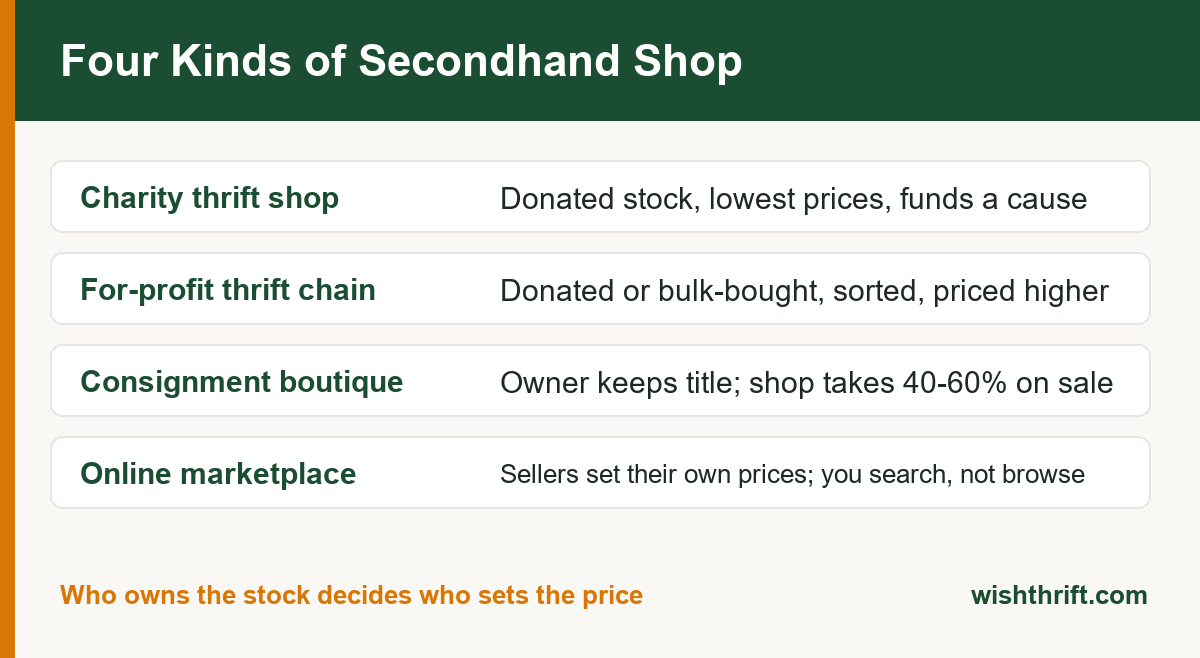
Charity thrift shops sell donated stock, with proceeds funding a cause. Prices are usually the lowest of any secondhand channel, and the stock is genuinely unpredictable because nobody chose it – it was given.
For-profit thrift chains also work from donated or bulk-bought stock, but operate as ordinary businesses. Prices sit somewhat higher, and the sorting is typically more thorough.
Consignment boutiques do not own their stock at all. Individual owners hand items over, the shop sells on their behalf and keeps a share of the sale price. Because a curator has accepted each piece, quality is more consistent and prices are higher – you are paying for the filtering. We cover the economics of that arrangement in our guide to how consignment works and what it costs.
Online resale marketplaces are where most thrifting now happens. Individual sellers list their own items and set their own prices, and buyers search rather than browse. The trade-off is direct: you lose the pleasure of an unplanned find, and you gain the ability to search the entire world for one specific item.
What is a thrifter?
A thrifter is someone who shops secondhand habitually. The word describes a habit rather than a motive, and the motives vary widely.
Some people thrift because it is what their budget allows. Some are deliberately avoiding fast fashion, since keeping an existing garment in use avoids the resources and emissions that making a new one would have required. Some are collectors hunting particular decades, labels or materials that are no longer produced. And some are resellers, buying items priced below what they are worth to a specific buyer and selling them on.
These groups shop very differently. A collector will pay a strong price for the right piece and ignore everything else; a budget shopper wants breadth and low prices; a reseller is scanning for mispricing. All of them are thrifters.
Why thrifting grew
Three forces pushed secondhand from a niche into an ordinary way to shop.
Price. The most straightforward reason. Everyday clothing in good condition typically sells for a small fraction of its original retail price, and for anyone dressing a growing child or furnishing a first flat, the difference is not marginal.
Environmental cost. Textile production is resource-intensive, and a garment that stays in use is a garment that did not need to be made. Buying secondhand is one of the few consumer choices where the lower-impact option is also the cheaper one.
Scarcity. This is the reason people underestimate. Clothing made twenty or thirty years ago cannot be bought new at any price, and for anyone who wants the fabrics, cuts and construction of a particular era, secondhand is not the cheap option – it is the only option. That is why genuine vintage from a sought-after label can sell for more than it originally cost. Our guide to the vintage brands worth looking for covers which names carry that premium.
How to start thrifting well
Learn to read a garment before you learn labels. Check the fabric composition, look at the seams inside, and feel the weight of the cloth. Natural fibres and dense construction tend to indicate something built to last, and this is knowledge that transfers to every item you ever pick up.
Always measure, never trust the size on the tag. Sizing has drifted enormously over the decades, and vintage sizing is not modern sizing. Carry the flat measurements of a garment that fits you well – chest, waist, length, shoulder – and compare against those instead.
Inspect for the flaws that matter. Underarms, collars, crotch seams, zips and the inside of cuffs. A missing button is trivial; thinning fabric at a stress point is not, because it will fail and cannot be repaired invisibly.
Go often rather than long. Stock turns over constantly and unpredictably, so ten short visits will beat one exhaustive one. Online, the same logic applies to saved searches.
Know roughly what things sell for. A price only reads as good or bad against a reference. Our guide to the items most worth thrifting is a reasonable starting point.
The other half of thrifting: selling
Most people arrive at thrifting as buyers and stay there, which quietly wastes the more valuable half of the habit. Every wardrobe already holds items that someone is actively searching for, and the same knowledge that makes you a good secondhand buyer – reading fabric, dating a piece, spotting a label that holds value – is exactly what makes you a good secondhand seller.
What decides your return is fees. Most resale platforms take a commission on every sale, and a percentage taken off the top is a permanent charge on a margin that is often thin to begin with. On a typical resale app, a £40 sale can lose several pounds to commission and payment handling before anything reaches you. Across a wardrobe clear-out of twenty items, that adds up to real money.
WishThrift takes no commission and charges nothing to list, so the price a buyer pays is the price you keep. If you want the mechanics – photographing, measuring, pricing and writing a listing that actually sells – our guide to selling used clothes online covers the full process, and the thrifting guides hub collects everything else.
Thrifting and vintage are related, not identical: a thrift shop sells whatever is donated, while a vintage store curates by decade and prices on rarity. Our guide to what a vintage clothing store really is sets out the difference between vintage, retro, antique, deadstock and reproduction — and what each is worth.
FAQ: Thrifting
What does thrifting mean?
Thrifting means buying secondhand items – most often clothing, but also furniture, books, electronics and homeware – from thrift stores, charity shops, car boot and yard sales, or online resale marketplaces. The defining feature is that the item has had a previous owner and is being sold at a fraction of its original retail price. Used as a verb, to thrift something is simply to buy it secondhand.
What is the difference between thrifting and shopping secondhand?
In practice there is no meaningful difference – thrifting is the everyday word for shopping secondhand. If anything, thrifting carries a slight connotation of hunting: browsing unsorted stock without knowing what you will find, rather than searching for one specific item. Buying a known piece from an online resale listing is still secondhand shopping, and most people would still call it thrifting.
Where does the word thrift come from?
Thrift entered Middle English from the Old Norse word thrift, meaning prosperity or success, and it shares a root with the verb thrive. Its modern sense of careful, economical management developed later, and the phrase thrift store took hold in the United States in the early twentieth century to describe the resale shops run by charitable organisations. The word originally described thriving, not scrimping.
What is a thrifter?
A thrifter is simply someone who shops secondhand regularly. The word covers a wide range – people buying out of necessity, people avoiding fast fashion for environmental reasons, collectors hunting particular eras or labels, and resellers buying underpriced items to sell on at a profit. It is a description of a shopping habit, not a single motivation.
Is thrifting actually cheaper than buying new?
Usually, and often dramatically so, but not automatically. Everyday secondhand clothing typically sells for a small fraction of its original retail price. Sought-after vintage and designer pieces are the exception: genuine archive items can sell for more than they originally cost, because the supply is fixed and the demand is not. The saving is real for ordinary items and unreliable for collectible ones.
Can you make money from thrifting?
Yes, and many people do. The model is straightforward – buy items priced below what they are worth to a specific buyer, then resell them to that buyer. It rewards knowledge rather than capital: knowing which labels, eras and materials hold value is what separates a profitable resell from a wasted purchase. Fees matter too, since a commission taken off every sale is a permanent tax on a thin margin.
Maya Chen is Senior Editor at WishThrift, where she writes about the global secondhand market, sustainable shopping, and the resale economy. Her work focuses on practical buyer guides — designer authentication, online thrift tactics, used-book hunting, and what to look for on every listing before you pay. She edits the WishThrift seller knowledge base and reviews every guide published on the site.