

The difference between a $200 vintage band tee and a $20 reprint usually comes down to four checks that take under a minute: the stitching, the tag, the fabric and — the one everyone gets wrong — understanding that the copyright date is the artwork’s date, not the shirt’s. Reprints are a legitimate market of their own, and this guide covers both sides honestly: how to confirm an original before paying vintage money, and how to price a reprint fairly when that is what you have.
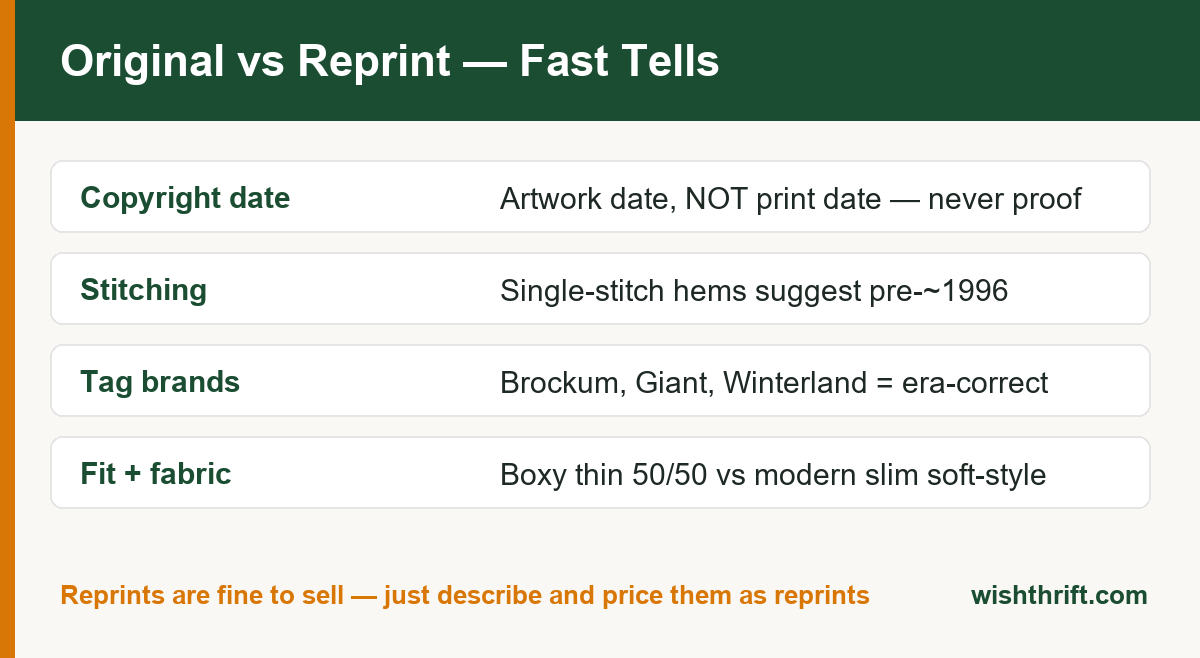
- The copyright-date myth costs buyers the most: a 1989 © line proves the artwork’s age, not the shirt’s.
- Single-stitch hems suggest pre-mid-90s manufacture; era tag brands (Brockum, Giant, Winterland, Screen Stars) confirm the decade.
- Originals are boxy and thin; modern reprints are slim-cut on soft-style blanks with crisp, dense prints.
- Reprints honestly sell for $10–$25 — the offence is not owning one, it is pricing one as an original.
Why Reprints Dominate the Market
Band artwork never stopped selling. Rights holders reissue classic designs through mainstream retail constantly, bootleggers print whatever the algorithm rewards, and both feed a resale market where the word vintage gets attached to anything with an old copyright year. The consequence: on any large marketplace, most shirts listed as vintage band tees are reprints, and the price spread between honest tiers is enormous — a real 1990s tour shirt can be worth ten times its licensed reissue. Every check below exists because of that spread.
Check 1: Kill the Copyright-Date Reflex
Flip any band tee and the print or tag often shows a © year. That year belongs to the artwork and travels with it forever — licensed reprints reproduce it accurately, decades later, because legally they must credit the rights holder. So a © 1991 line on a shirt is consistent with a 1991 original and equally consistent with a reprint made last year. Treat the copyright line as one input that must agree with the physical evidence, never as proof on its own.
Check 2: Stitching and Construction
Turn the shirt inside out and look at the bottom hem and sleeve ends. A single row of stitching — single-stitch construction — was standard until roughly the mid-1990s, after which manufacturers broadly moved to double-stitch. Single stitch therefore points a shirt at the 80s and early 90s, which is why sellers headline it. Two cautions: some modern boutique blanks deliberately reproduce single-stitch construction, and plenty of genuine late-90s shirts are double-stitched. Strong signal; not a verdict.
Check 3: The Tag
The tag is the closest thing to a birth certificate. Licensed-merch printers like Brockum, Giant and Winterland dominated late-80s and 90s band merchandise, and era blanks — Screen Stars, period Hanes and similar 50/50 tags — place a shirt in its decade by layout and typography alone. A missing tag is common (they were scratchy; people cut them) and not disqualifying, but it removes your best evidence, which should show in the price. A current-era blank under a supposedly 1993 print, on the other hand, ends the conversation.
Check 4: Fabric, Fit and the Print Surface
Originals from the 80s and 90s are typically thin — often 50/50 cotton-poly with decades of washing behind them — and cut boxy: wide in the body, shorter in the sleeve. Modern reprints sit on today’s soft-style blanks: slimmer, longer, heavier-feeling ringspun cotton. The print surface tells the same story. Old screen prints crack and soften along the fabric’s wear patterns; a crisp, dense, perfectly intact print of a thirty-year-old design is announcing its reprint status. Run your thumb across it — age has a texture that fresh plastisol does not.
Honest Prices for Every Tier (2026)
| Tier | Typical resale | Notes |
|---|---|---|
| Verified original tour/promo shirts | $60–$300+ | Band, design and condition set the ceiling; grails far exceed it |
| Licensed reprints / retail reissues | $10–$25 | Legitimate merchandise at honest prices |
| Quality reprints of grail designs | $20–$30 | The artwork carries demand even in reissue form |
| Bootlegs (modern, unlicensed) | $10–$20 | Sell only described as bootlegs; era bootlegs can be collectible |
For what specific original graphics bring — and where to find them cheap — our vintage band tees thrifting guide covers the hunting side, with band-specific values in our Deftones merch guide and Arctic Monkeys merch guide.
Where Even Experienced Buyers Slip
Three edge cases cause most of the expensive mistakes. First, era bootlegs: unlicensed shirts printed in the 80s and 90s are genuinely old garments — they pass the stitching, tag and fabric checks — but they were never official merch, and while some have real collector followings, they are their own tier and should be described as period bootlegs, not originals. Second, deadstock originals: a real 1992 shirt that sat unworn in a warehouse will show crisp print and bright fabric, failing the age-texture test while passing everything else — this is where the tag and construction evidence has to carry the verdict alone. Third, modern single-stitch reproductions: several current blank makers deliberately reproduce vintage construction, which is why stitching can never be the only check you run. The discipline that survives all three cases is the same: no single test is proof, and a shirt earns the word original only when every piece of physical evidence agrees.
Selling Either Tier the Right Way
If it is an original, prove it: photograph the hem stitching, the tag and a macro of the print surface — the three images experienced buyers look for before they read a word. If it is a reprint, say so in the first line and price inside the reprint band; described honestly, reprints sell quickly and never come back as disputes. Either way, state pit-to-pit and length, since fit is half of what tee buyers are purchasing. Fees eat thin margins in this category, which is why sellers move volume where listing is free: list your tees free on WishThrift and keep the full price of every tier. Our guide on selling vintage clothes online covers the keyword and photo habits that make graphic tees move.
FAQ: Band Tee Reprints
Does the copyright date on a band tee tell me when it was printed?
No — this is the single most expensive misunderstanding in vintage tees. The copyright date refers to the artwork, and licensed reprints reproduce it faithfully decades later. A shirt printed last year can legitimately carry a 1989 copyright line. Date the garment, not the graphic: stitching, tag brand and fabric are what establish when a shirt was actually made.
What is the difference between a licensed reprint and a bootleg?
A licensed reprint is legally produced under the band’s merchandising rights — the reissues sold in mainstream stores are typical examples — and is a legitimate product at the right price. A bootleg is an unlicensed print. Both are worth far less than originals, but licensed reprints are honest merchandise, while bootlegs of famous designs sold as originals are simply fraud.
Are reprint band tees worth anything?
Modestly, yes. Licensed reprints in good condition typically resell for $10 to $25, and well-made reprints of grail designs can reach $30 because the artwork itself carries demand. Some early bootlegs from the 80s and 90s have even become collectible in their own right. The value problem is never the reprint — it is the reprint priced as an original.
What tag brands indicate a genuinely vintage band tee?
Era printers and blank makers are the strongest signal: names like Brockum, Giant and Winterland were the licensed-merch giants of the late 80s and 90s, and blanks such as Screen Stars and period Hanes 50/50 place a shirt in its decade. Learn the handful of era brands for the period you collect, and treat unfamiliar or modern tags on ‘vintage’ listings as the question to resolve first.
Maya Chen is Senior Editor at WishThrift, where she writes about the global secondhand market, sustainable shopping, and the resale economy. Her work focuses on practical buyer guides — designer authentication, online thrift tactics, used-book hunting, and what to look for on every listing before you pay. She edits the WishThrift seller knowledge base and reviews every guide published on the site.