



Every real Pucci top carries its own certificate of authenticity: the word “Emilio” hand-written in tiny script, hidden over and over inside the print itself. Find that signature and check it against the label era, and you can authenticate most vintage Emilio Pucci in under a minute — which matters, because original 60s and 70s silk jersey pieces now sell for $150 to $600+ while lookalike psychedelic prints clog every vintage market. This guide covers the signature check, labels by era, the budget-friendly Formfit Rogers line, realistic 2026 values, and how to care for fabrics that are older than most buyers.
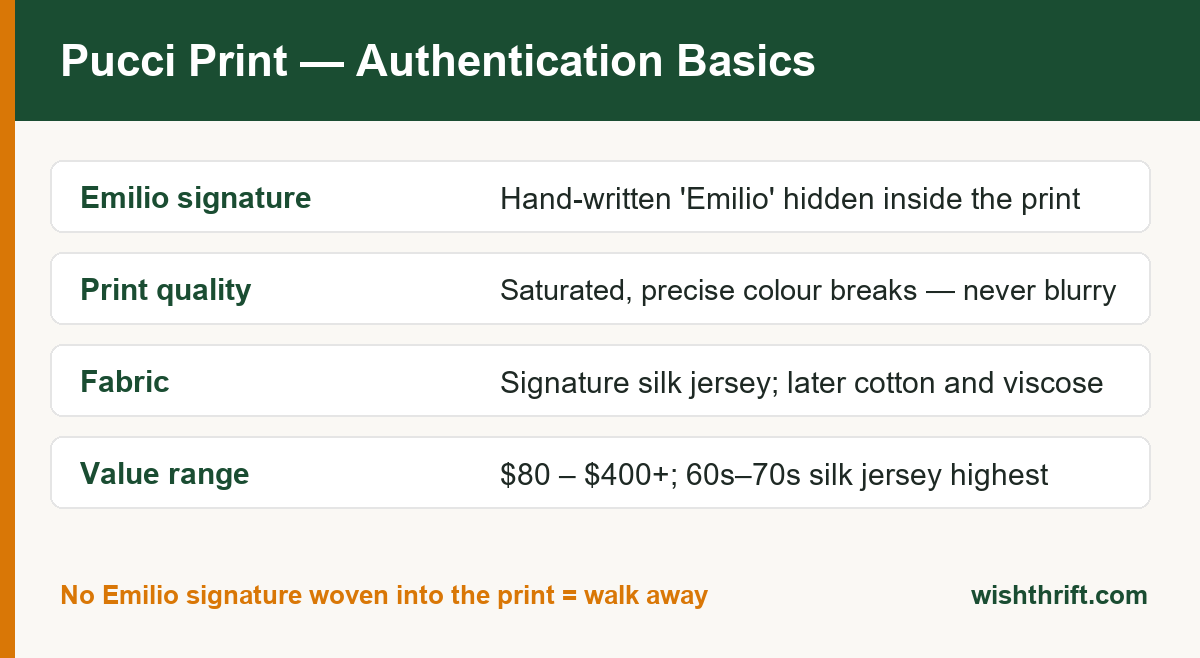
- The authentication anchor: “Emilio” hand-written repeatedly inside the print — no signature, no Pucci.
- Value tiers: 60s–70s silk jersey $150–$600+, Formfit Rogers (EPFR) $40–$150, 90s–2000s pieces $80–$250.
- EPFR — Pucci’s licensed lingerie/loungewear line — is the affordable authentic entry and a genuine thrift-store possibility.
- Silk jersey demands care: dry clean or cold hand wash, dry flat, store folded, keep out of sunlight.
Why Pucci Prints Are Back in Demand
Emilio Pucci opened his Florence fashion house in 1947 and by the 1960s had dressed the jet set in something nobody else made: kaleidoscopic, swirling geometric prints in colour combinations that still look electric, cut in lightweight silk jersey that packed into a suitcase and emerged unwrinkled. Marilyn Monroe was famously devoted to the brand. Sixty years later, the Y2K revival’s love of bold prints, the resort-wear renaissance and a wave of archival dressing have pushed vintage Pucci back to the centre of the collectible market — and because the prints are so distinctive, they are also endlessly imitated, which is exactly why the authentication basics below earn you real money in both directions.
The Emilio Signature: Your First and Best Check
Genuine Pucci prints incorporate the designer’s first name — “Emilio” — hand-written in small, slightly irregular script woven into the pattern, typically repeated at intervals along curves and colour boundaries. Scan any busy section of the print for a few seconds and it should appear. Two cautions: on very small pieces (scarves, trim) the signature may appear sparsely, and wear can fade it — so treat absence as disqualifying but presence as step one, not final proof. Counterfeiters do sometimes print a crude “Emilio”, which is where step two comes in: print quality. Authentic Pucci colour is deeply saturated with crisp, confident boundaries between shades; fakes and homages blur at the transitions, mis-register colours, or print on visibly cheap thin fabric.
Reading the Labels by Era
Label style brackets the decade, and the decade sets the price band:
- 1950s–60s: “Emilio Pucci Florence-Italy” script labels, often alongside luxury retailer co-labels — the collector tier.
- 1960s–70s licensed lines: “Emilio Pucci for Formfit Rogers” on lingerie and loungewear; Pucci-designed prints under an American licence (more below).
- 1970s–80s: script branding continues with fabric-content tags reflecting US import rules; silk jersey, cotton and velvet all appear.
- 1990s–2000s (LVMH era from 2000): cleaner modern labels, viscose blends common, sizing conventions modern — wearable rather than archival prices.
Cross-check that the label era matches the print style and fabric: a “60s” label on polyester microfibre is telling you a story that does not add up. This is the same clue-stacking method from our best vintage brands guide, applied to a single house.
Formfit Rogers: The $40 Door into Real Pucci
In the 1960s Pucci designed a full line of slips, nightgowns, robes and loungewear manufactured under licence by the American underwear maker Formfit Rogers — labelled “Emilio Pucci for Formfit Rogers” (collectors say EPFR). The prints are authentic Pucci designs on nylon jersey, sold through US department stores in real volume, which means EPFR pieces still surface in ordinary thrift stores mispriced as generic vintage nightwear. At $40–$150 resale they are the affordable way to own the print — and finding one for $4 in a sleepwear bin is precisely the kind of score our thrift finds worth a fortune piece catalogues. Worn as tops and slip dresses today, they are also simply beautiful clothes.
What a Vintage Pucci Top Is Worth in 2026
| Tier | Typical resale | Notes |
|---|---|---|
| 1960s–70s silk jersey tops & blouses | $150–$600+ | Exceptional prints, sets and couture-line pieces exceed this |
| EPFR lingerie & loungewear | $40–$150 | Condition-sensitive; unworn pieces at the top of the band |
| 1990s–2000s viscose/cotton tops | $80–$250 | Wearable-vintage market; Y2K-era pieces rising |
| Damaged (stains, pulls, altered) | $25–$80 | Print collectors still buy for framing and repair |
Condition dominates: silk jersey pulls easily, underarm staining is common and mostly permanent, and sun-faded panels halve values. Photograph flaws honestly — Pucci buyers are informed and forgiving of disclosed wear, unforgiving of surprises.
Care: Protecting Sixty-Year-Old Silk
Dry clean silk jersey, or hand wash cold in a silk detergent without wringing; roll in a towel, dry flat, and keep it out of direct sun — the saturated dye that makes the print valuable is what sunlight destroys. Store folded in acid-free tissue rather than hung (hangers distort jersey shoulders), and keep cedar or lavender nearby: moths agree with collectors about natural fibres. EPFR nylon is tougher — gentle hand wash, drip dry, done.
Found One? Selling It Right
A Pucci top is a top-tier flip, and listing quality decides whether you capture it. Title with “Emilio Pucci”, the era, garment type and bust measurement. Photograph the signature in the print close-up — it is your listing’s proof — plus the label, full front and back, and every flaw. Price from the table and let informed buyers come. On WishThrift you list free and keep 100%: on a $300 silk jersey sale, that is $30–$60 saved versus commission platforms. For the broader designer-selling method — pricing psychology, offer handling, safe shipping — see selling designer clothes.
FAQ: Pucci Top
How do I know if a Pucci top is real?
Start with the print itself: authentic Emilio Pucci prints have the word ‘Emilio’ hand-written in small script hidden repeatedly within the pattern. Then check print quality — genuine Pucci colour is saturated with precise boundaries between shades — and the label, which should match verified examples from its era. A swirling 60s-style print with no Emilio signature anywhere is not Pucci, whatever the listing says.
What is a vintage Pucci top worth?
In 2026, 1960s–70s silk jersey pieces in good condition typically bring $150 to $600 and can exceed that for exceptional prints and couture-line items. Pieces from the Formfit Rogers lingerie and loungewear collaboration usually sell for $40 to $150, and 1990s–2000s viscose and cotton pieces run $80 to $250. Condition — especially staining and pulls in silk jersey — moves every band substantially.
What is Emilio Pucci Formfit Rogers?
In the 1960s Pucci designed a lingerie, sleepwear and loungewear line manufactured under licence with the American underwear maker Formfit Rogers, labelled ‘Emilio Pucci for Formfit Rogers’ or EPFR. The prints are genuine Pucci designs on nylon jersey, which makes EPFR the most affordable authentic entry into vintage Pucci — and a common thrift-store discovery, since it sold in US department stores in volume.
How should I wash a vintage Pucci top?
Silk jersey should be dry cleaned, or at most hand washed cold with a silk-safe detergent, never wrung, and dried flat away from sunlight — the saturated dyes that make Pucci valuable are the same dyes that fade. Nylon EPFR pieces tolerate gentle hand washing better. Iron only on the lowest setting through a cloth, and store folded rather than on hangers, which distort knit jersey shoulders.
Maya Chen is Senior Editor at WishThrift, where she writes about the global secondhand market, sustainable shopping, and the resale economy. Her work focuses on practical buyer guides — designer authentication, online thrift tactics, used-book hunting, and what to look for on every listing before you pay. She edits the WishThrift seller knowledge base and reviews every guide published on the site.