

A lolita dress is the centrepiece of lolita fashion — a Japanese street style built on Victorian and Rococo references: full knee-length skirts over petticoats, modest necklines, and construction quality that mainstream fast fashion abandoned decades ago. Two things newcomers need to know first: it is everyday alternative fashion, not a costume (and unrelated to the novel its name unfortunately echoes), and it has one of the healthiest secondhand markets in all of fashion, where $300 dresses routinely change hands for $80–$150. This guide covers the substyles, the JSK/OP distinction, brand tiers, the quality checks that matter, and how to buy secondhand without falling for replicas.
- Lolita is a modest Japanese street fashion with sweet, classic and gothic substyles — not costume wear.
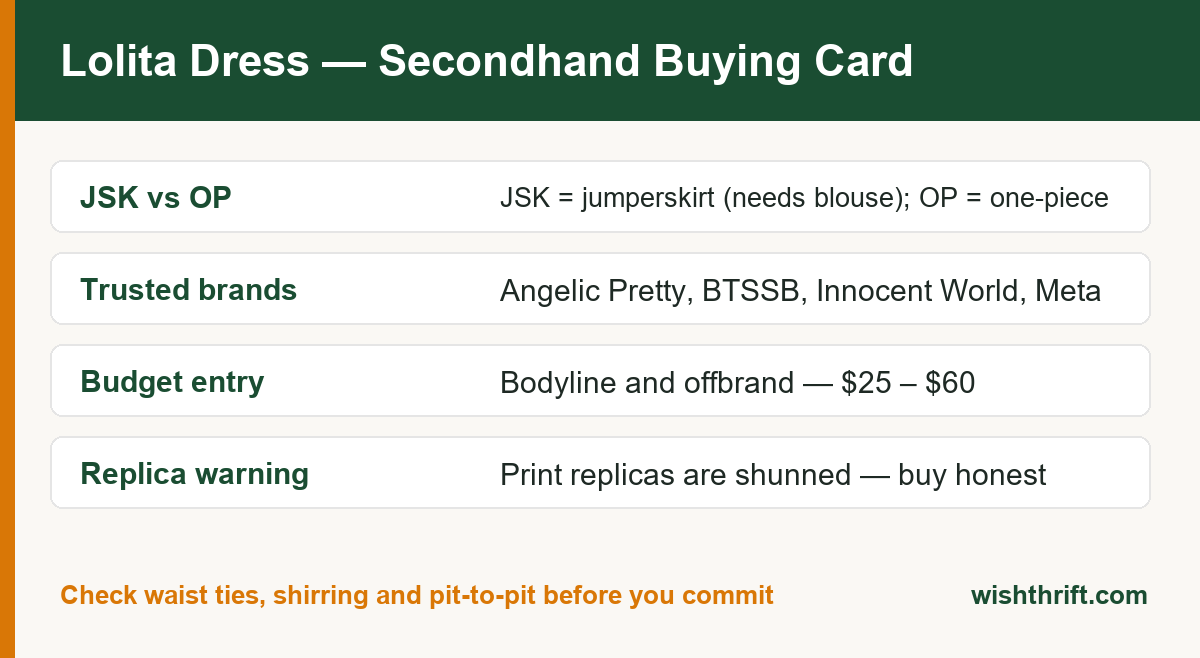
- JSK = sleeveless jumperskirt worn over a blouse (the versatile starter); OP = one-piece with sleeves, worn alone.
- Brand tiers: Angelic Pretty / BTSSB / Innocent World / Moitié at $80–$250 secondhand; Bodyline budget entry at $25–$60.
- Buy by measurements (bust, waist, shirring range) and learn prints to avoid replicas, which the community rejects.
What Lolita Fashion Actually Is
Lolita emerged from Japanese street fashion in the 1980s–90s as a deliberately elegant, modest counterpoint to mainstream trends, drawing on Victorian children’s wear, Rococo silhouettes and old-school romanticism. The name is an unfortunate historical accident of Japanese-English borrowing — the fashion has nothing to do with the novel, and its aesthetic is emphatically about self-expression and elegance rather than anyone else’s gaze. A full coordinate (“coord”) builds outward from the dress: petticoat for silhouette, blouse under a JSK, legwear, shoes and a headpiece. The result reads formal to outsiders, but for wearers it is simply what they wear — to meetups, brunches and ordinary Tuesdays.
The Three Main Substyles
| Substyle | Look | Flagship brands |
|---|---|---|
| Sweet (ama-loli) | Pastels, dessert and animal prints, generous lace and bows | Angelic Pretty, Baby the Stars Shine Bright |
| Classic | Muted florals, tea-length elegance, Victorian restraint | Innocent World, Victorian Maiden, Mary Magdalene |
| Gothic | Black and jewel tones, crosses, cathedral romance | Moi-même-Moitié, Atelier Boz |
Metamorphose temps de fille spans sweet and classic; punk, country and other niche substyles orbit these three. Most wardrobes eventually specialise, but your first dress does not need to commit you.
JSK vs OP: The Distinction That Shapes Your Wardrobe
A JSK (jumperskirt) is sleeveless, designed over a blouse — the workhorse cut, because one JSK with a white blouse, a black blouse and different legwear produces several distinct coords. An OP (one-piece) has built-in sleeves and stands alone, which makes it simpler but less remixable. Skirts (SK) extend wardrobes later. Beginners: one JSK, two blouses, one properly poofy petticoat — that is a functioning lolita wardrobe, and secondhand it costs less than a single new brand dress.
Brand Tiers and Secondhand Prices
The Japanese houses — Angelic Pretty, Baby the Stars Shine Bright (BTSSB), Innocent World, Victorian Maiden, Moi-même-Moitié, Metamorphose — set the quality standard: printed original fabrics, quality torchon or tulle lace, full linings, waist ties and often back shirring. New they run $250–$400; secondhand, ordinary releases settle at $80–$250 while grail prints climb. Bodyline, the long-running budget label, offers solid basics at $25–$60 secondhand and is the community’s standard recommendation for a first dress. Independent and Chinese indie brands span the range between — judged, like everything in lolita, on construction and fabric rather than the name alone. Quality checks before any purchase: lace should be soft and detailed (scratchy raschel lace is the classic budget tell), prints should be crisp, seams finished, and shirring elastic alive.
Buying Secondhand: Measurements and Replica Ethics
Lolita is bought and sold flat-measured. Ask for bust and waist ranges (shirred dresses list minimum–maximum), skirt length, and whether waist ties and detachable pieces are present; check photos for underarm wear, print fading and lace damage. Then the community’s one hard rule: replicas of brand prints are rejected — they copy a designer’s artwork outright, usually with muddy colours and shiny polyester, and honest sellers label non-brand dresses “offbrand” rather than imitating. Learn the print you want from the brand’s own reference photos, compare tag and print in listing photos, and treat a famous print at a too-good price exactly as you would a $60 designer bag: as a fake announcing itself. Offbrand originals, to be clear, are entirely respected — it is copied prints the community shuns. The same verification mindset from our fake designer guide applies, just with print libraries instead of serial numbers.
Caring for Dresses Built to Last
Hand wash in cold water or use a lingerie bag on the gentlest cycle only when the care tag allows; many printed cottons wash beautifully, but anything with delicate lace, chiffon overlays or flocking should be spot-cleaned or dry cleaned. Dry flat or hung by the waist (never by the shoulders of a heavy dress), store with the petticoat separate to preserve its poof, and fold prints away from direct sunlight. A cared-for brand dress genuinely holds value — many resell within $30 of their purchase price years later, which makes lolita one of the few fashions where the wardrobe is nearly an asset class.
Selling a Lolita Dress
Because the market is measurement-driven and print-literate, good listings sell fast: name the brand, print name if known, cut (JSK/OP/SK), colourway, and flat measurements including shirring range; photograph the tag, the print up close, the lace, and any flaws under daylight. Completeness matters — waist ties and detachable bows change the price. On WishThrift you can list your dress free and keep the full sale price, message buyers directly to share extra photos, and reach thrift-minded buyers worldwide — see how to sell used clothes online for the general playbook, then apply this guide’s vocabulary to reach the community that is already searching for exactly what is hanging in your closet.
FAQ: Lolita Dress
What is a lolita dress?
A lolita dress is the centrepiece of lolita fashion, a Japanese street style inspired by Victorian and Rococo clothing: knee-length full skirts shaped by petticoats, high or modest necklines, and detailed construction with quality lace and printed fabrics. It is an everyday alternative fashion with its own community and rules of coordination — it is not a costume and not related to the novel its name echoes.
What is the difference between a JSK and an OP?
A JSK (jumperskirt) is a sleeveless dress designed to be worn over a blouse, making it the more versatile and common cut — you change the look by changing the blouse. An OP (one-piece) has built-in sleeves and can be worn alone. Beginners usually start with a JSK plus one white and one black blouse, which yields several distinct coordinates from a single dress.
Which lolita brands should I look for secondhand?
The established Japanese houses are Angelic Pretty and Baby the Stars Shine Bright for sweet styles, Innocent World and Victorian Maiden for classic, and Moi-même-Moitié for gothic, with Metamorphose temps de fille spanning several. Bodyline is the long-standing budget label at $25 to $60 secondhand. Brand dresses typically resell between $80 and $250, with sought-after prints going higher.
How do I avoid replica lolita dresses?
Learn the print you want: replicas copy specific brand print designs, usually with muddier colours, cheaper lace and polyester that photographs shiny. Check that the interior tags match the claimed brand, compare the print against the brand’s own reference images, and treat far-below-market prices on famous prints as the warning they are. The community strongly discourages print replicas, and honest listings will always name a dress as offbrand rather than imply it is brand.
Maya Chen is Senior Editor at WishThrift, where she writes about the global secondhand market, sustainable shopping, and the resale economy. Her work focuses on practical buyer guides — designer authentication, online thrift tactics, used-book hunting, and what to look for on every listing before you pay. She edits the WishThrift seller knowledge base and reviews every guide published on the site.