

Designer clothes hold serious resale value – luxury ready-to-wear typically resells for 35-60% of retail, and Chanel or Hermès pieces can fetch 60-100%+ – but where you sell decides how much of that you keep. Consignment platforms take anywhere from 15% to 60% of the sale; selling directly on a zero-fee marketplace like WishThrift means the entire price is yours. The trade-off is that you do the authentication legwork yourself. This 2026 guide covers what each brand tier is worth, the real math of consignment versus direct sale, and how to authenticate and list so buyers trust you.
Know exactly what you have
Before pricing anything, gather the facts buyers pay for: the brand and the line (Marc Jacobs mainline is not Marc by Marc Jacobs), the style name or number if you can find it, fabric composition, size, and any provenance – original receipts, garment bags, spare buttons, tags. A photographed receipt or original tag can add 10-20% to the price because it de-risks the purchase.
What designer clothes are worth in 2026
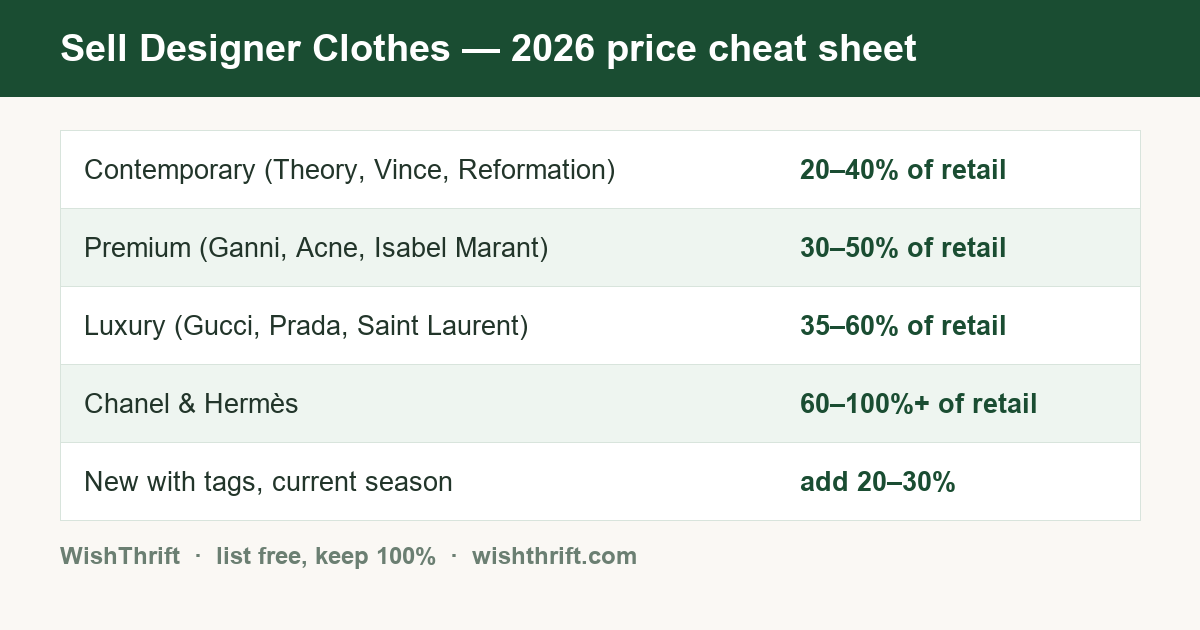
| Brand tier | Typical resale |
|---|---|
| Contemporary (Theory, Vince, Reformation) | 20-40% of retail |
| Premium (Ganni, Acne Studios, Isabel Marant) | 30-50% of retail |
| Luxury RTW (Gucci, Prada, Saint Laurent) | 35-60% of retail |
| Chanel & Hermès | 60-100%+ of retail |
| New with tags, current season | add 20-30% |
Within each tier, classics beat trend pieces: a black Saint Laurent blazer outsells last year’s runway experiment at the same retail price. Condition grading matters too – use the standard language (NWT, EUC, and honest notes below that) the way our selling guide lays out.
The consignment math
Here is what actually happens to a Gucci blazer that sells for $600, at typical published rates as of July 2026:
| Route | Typical cut | You receive |
|---|---|---|
| The RealReal (consignment) | seller payout tiers ~20-70%, mid-range items ~50-55% | ~$300-$330 |
| Vestiaire Collective | ~15-25% + processing | ~$460-$500 |
| Poshmark | 20% | $480 |
| eBay | ~13% | ~$520 |
| WishThrift (direct) | 0% | $600 |
Rates vary by item value and category – always check the platform’s current schedule.
Consignment buys you convenience and their authentication stamp; it costs you $100-$300 on a single mid-value piece. If you can document authenticity yourself, direct sale keeps that money.
Your closet, your margin. List designer pieces free and keep the full sale price.
Authenticate before you list
Buyers of secondhand luxury are – rightly – fake-alert, so do the proving for them: photograph the brand label, fabric/care tag, serial or date tags where the brand uses them, hardware engravings, and stitching close-ups. Cross-check construction details against our guide to spotting fake designer items. Never use the word “authentic” casually on something you can’t back up – if you inherited a piece and aren’t sure, say “believed authentic, purchased at [store], no receipt” and price accordingly. For bags specifically, our handbag selling guide covers serial formats by brand.
Photos and the listing
Ten photos minimum: front, back, side, lining, all tags, hardware, and macro shots of any wear – a pulled thread photographed honestly builds more trust than a suspiciously flawless listing. Shoot on a plain background in daylight. In the title, lead with brand, piece and size (“Isabel Marant Étoile linen blazer, FR38/US6”); in the description add measurements flat (pit-to-pit, length, sleeve), fabric, season/year if known, and retail price.
Pricing and selling strategy
Check sold – not asking – prices: eBay’s sold-listings filter is the fastest free comp source. Price 10-15% above your target to leave offer room, and be patient: designer pieces sell slower than fast fashion but at real money. Ship insured with signature confirmation, photograph the packing process for high-value pieces, and keep all communication on-platform.
What doesn’t sell (and what to do instead)
Three types of designer piece consistently disappoint at resale: heavily logo-dated trend pieces from lower tiers (last decade’s monogram belt), formal pieces in very small or very large sizes outside the common range, and anything with altered tailoring that changed the original cut. These still sell – but at fast-fashion prices, and sometimes faster in a bundle with stronger pieces than alone. If a piece has sat unsold for two months, drop the price 15% and refresh the photos rather than letting a stale listing signal that something is wrong with it. And if it is genuinely special but slow – archival, collectible, unusual – patience is the strategy: the right buyer searches eventually, and a zero-fee listing costs nothing to keep live.
Timing and presentation for luxury pieces
Luxury resale has seasons too: outerwear and knits peak September-January, silk and linen March-July, and party pieces surge before the holidays. Steam every piece before photographing, shoot on a wooden hanger against a plain wall, and include a scale reference for details – a serial tag photographed with a fingertip reads as transparency. Write the description like a store would: fabric first, then cut, then condition, then provenance. Buyers spending three figures on a used garment are buying your credibility as much as the piece; every specific, verifiable detail you add – measurements, season codes, purchase story – is worth real money in the final price. When the wardrobe includes bags, our handbag guide covers the serial-number formats brand by brand.
Your pre-listing checklist for designer pieces
Run every piece through this before it goes live: label, care tag and any serial photographed sharp and well-lit; fabric composition stated exactly as the tag reads; measurements taken flat and listed in inches; season or year stated if known, “unknown” said plainly if not; every flaw photographed at macro distance with a one-line honest note; provenance stated – where bought, receipt or not; the exact style name searched on eBay sold listings for a price floor; your price set 10-15% above target with offers enabled mentally priced in; insured, signature-required shipping cost calculated before you promise it; and the first photo strong enough to stop a scroll, because on every marketplace the first photo does 80% of the work. This is the discipline that separates listings that sell at luxury prices from identical garments that sit for months.
FAQ: selling designer clothes
Where is the best place to sell designer clothes online?
If you want zero effort, consignment (The RealReal, Vestiaire) – at the cost of 30-60% of the sale. If you want the full price, sell direct on a zero-fee marketplace like WishThrift and document authenticity yourself with tag, serial and receipt photos.
How much do designer clothes resell for?
Contemporary labels 20-40% of retail, premium labels 30-50%, luxury houses 35-60%, and Chanel/Hermès 60-100%+. New-with-tags current-season pieces add 20-30% to those ranges.
How do I prove my designer clothes are real?
Photograph brand labels, care tags, serial/date codes, hardware and stitching, plus any receipts or original packaging. Describe exactly what you know and don’t know about provenance – specific, verifiable detail is what convinces experienced buyers.
Is it worth selling old designer clothes?
Almost always – classic pieces from luxury houses hold value for decades, and even worn contemporary-label pieces return 20-40% of retail. The exceptions are heavily trend-dated pieces from lower tiers, which sell but at fast-fashion prices.
Maya Chen is Senior Editor at WishThrift, where she writes about the global secondhand market, sustainable shopping, and the resale economy. Her work focuses on practical buyer guides — designer authentication, online thrift tactics, used-book hunting, and what to look for on every listing before you pay. She edits the WishThrift seller knowledge base and reviews every guide published on the site.