
Consignment means handing an item to a shop that sells it on your behalf and keeps a share of the sale price – typically 40% to 60% – paying you the rest only after it sells. You keep ownership of the item the entire time it sits in the shop. If it never sells, it comes back to you.
- The shop never buys your item – you own it until a buyer does.
- You are paid after the sale, not when you hand it over.
- The shop’s cut is usually 40-60% of the final price.
- Consignment is worth it for items that need authentication or a specialist buyer.
- For ordinary items, the commission is a very large charge for shelf space.
How consignment actually works
The mechanics are consistent across most shops, and each step carries a condition worth reading before you agree to it.
1. The shop accepts or rejects your item. Consignment shops curate, because their reputation rests on what is on the rail. Expect the majority of what you bring to be declined, particularly anything mass-market, worn, or out of season.
2. The shop sets the price. This is the step sellers most often misread. In almost all consignment agreements pricing is the shop’s decision, not yours – and their incentive is to move stock at a reliable pace, which is not always the same as achieving the highest price for your particular item.
3. A consignment period starts. Usually 60 to 90 days, very often with automatic markdowns built in – for example 20% off after 30 days and 40% off after 60. Your eventual payout is a percentage of whatever the marked-down price turns out to be, not of the original ticket.
4. It sells, and the split is applied. The shop keeps its commission and credits you the balance.
5. You are paid on the shop’s schedule. Commonly monthly, and often as store credit unless you specifically request cash – store credit is frequently offered at a better rate precisely because it keeps the money inside the shop.
6. Unsold items return to you – if you collect them. Most agreements give you a short window after the period ends, after which unclaimed items are donated or become shop property. This clause is in nearly every contract and is missed by nearly every seller.
What you actually keep
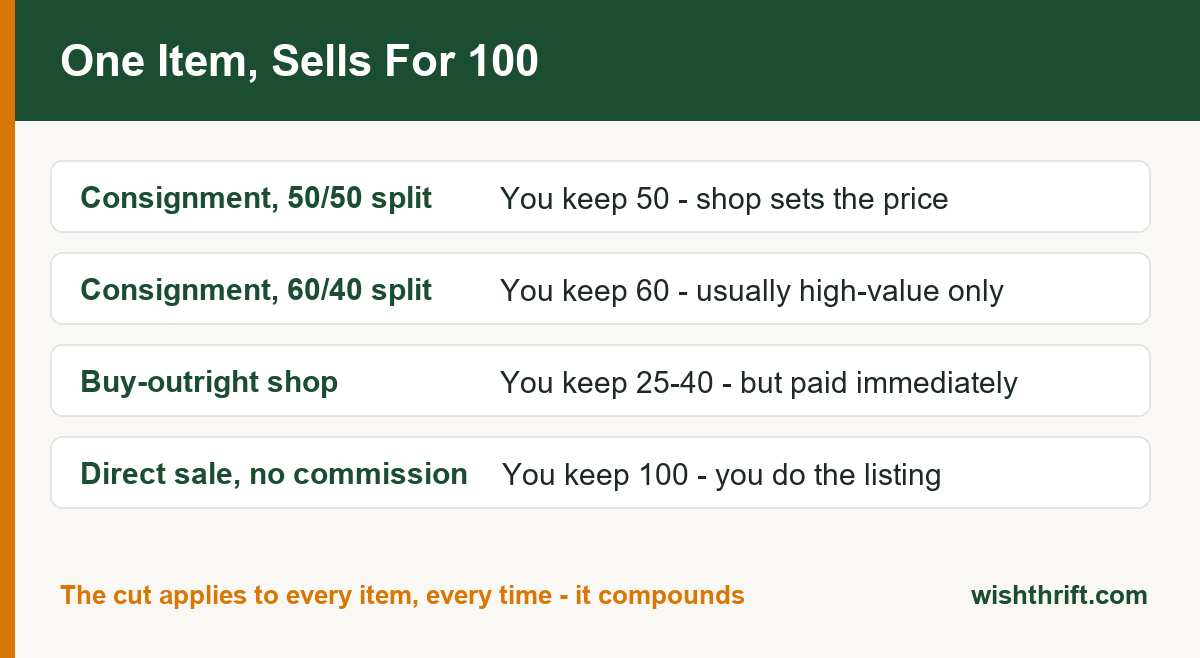
Take a single item that sells for 100 units of currency and follow it through each channel.
| Channel | You receive | What you give up |
|---|---|---|
| Consignment shop, 50/50 split | 50 | Half the value, plus control of pricing |
| Consignment shop, 60/40 in your favour | 60 | Pricing control; usually only offered on higher-value items |
| Buy-outright secondhand shop | 25-40, paid immediately | Most of the value, in exchange for certainty |
| Commission-charging resale app | 85-95 | A percentage of every sale, forever |
| Direct sale, no commission | 100 | You do the photographing, listing and messaging |
The important part is not any single row – it is what the difference does across a wardrobe. Clearing twenty items at an average of 40 through a 50/50 consignment shop returns 400. The same twenty items sold directly return 800. The commission is not a one-off cost; it applies to every item, every time.
When consignment is genuinely the right choice
There are real cases where handing over half the value is a sensible trade, and it is worth being honest about them.
High-value designer pieces that need authentication. A buyer spending a significant sum on a designer handbag needs to believe it is genuine. An established consignment shop that stakes its reputation on authentication solves a trust problem that a private seller cannot easily solve alone, and that can be worth more than the commission costs.
Items with a specialist local buyer base. Formalwear, occasion pieces, bridal, certain furniture. If a shop has spent years building exactly the audience your item needs, it may sell there in a fortnight and nowhere else in a year.
When your time is genuinely worth more than the difference. Consignment is the only channel where you hand over one bag and do nothing further. If clearing a wardrobe would otherwise never happen at all, half of something beats all of nothing.
Estate clearances and large volumes. When there is simply too much to photograph and list individually, a shop absorbing it in one go has obvious value.
When it is not worth it
For ordinary secondhand clothing, consignment is an expensive way to sell. An item that will realistically fetch 20 to 40 returns 10 to 20 after a standard split – and that is before automatic markdowns, which can quietly halve the figure again before your item sells at all.
Three things compound the problem. You do not control the price, so a markdown schedule can cut your return without your involvement. You wait months rather than days. And most of what you bring will simply be declined, which means consignment cannot clear a wardrobe even when you want it to – it only ever takes the top slice.
Selling direct instead
Direct selling means listing the item yourself, setting your own price, and keeping the proceeds. The work is real but modest: photograph the item in daylight, measure it flat, describe the flaws honestly, and answer messages.
The trade is straightforward. Consignment buys convenience with a large, permanent share of your money. Direct selling costs you perhaps fifteen minutes per item and keeps the rest. Where a shop’s authentication or specialist audience genuinely solves a problem, that share can be worth paying. For a normal wardrobe of normal clothes, it usually is not.
WishThrift takes no commission and charges nothing to list – the price a buyer pays is the price you keep. If you want the practical mechanics, our guide to selling used clothes online walks through photographs, measurements and pricing, and what thrifting means covers the buying side of the same market.
FAQ: Consignment
What does consignment mean?
Consignment is an arrangement where you hand an item to a shop or platform that sells it on your behalf, keeps a share of the sale price as commission, and pays you the remainder only after it sells. Crucially, you keep legal ownership of the item the whole time it sits on the shop floor – the shop never buys it from you. If it does not sell, it comes back to you.
How much do consignment shops take?
Most independent consignment shops keep somewhere between 40% and 60% of the final sale price, with a 50/50 split being the common starting point. Higher-value items sometimes attract a more seller-favourable split, because the shop earns an acceptable amount on a smaller percentage. Online consignment services often work on tiered payouts instead, where the percentage you receive scales with the item’s sale price and low-priced items pay very little.
What is the difference between consignment and buy-outright?
With consignment you keep ownership and get paid only when the item sells, so the shop takes no risk and you take all of it. With a buy-outright arrangement the shop purchases the item from you immediately at a lower price, takes ownership, and keeps whatever it later sells for. Buy-outright pays less but pays now and pays certainly; consignment pays more but only if a buyer appears.
Is consignment worth it?
It depends almost entirely on the item. Consignment earns its cut when the shop provides something you genuinely cannot: authentication for a high-value designer piece, a specialist local buyer base, or simply removing all the work from you. For an ordinary garment worth £20 to £40, a 50% commission is a very large charge for shelf space, and selling it directly will usually leave you meaningfully better off.
What is consignment stock?
Consignment stock is inventory sitting in a shop that the shop does not own. It is a normal arrangement in wholesale and retail as well as secondhand: the supplier retains ownership until the goods sell, and the retailer pays only for what actually sells. The retailer carries no capital risk and no unsold-stock loss, which is precisely why the arrangement exists – the risk sits with whoever owns the goods.
Do consignment shops pay you upfront?
No. Payment comes after the item sells, and most shops settle on a schedule – commonly monthly – rather than immediately on sale. Many also operate a consignment period, often 60 to 90 days, with prices marked down automatically as it runs on. If the item has not sold by the end of the period, you usually have a window to collect it before it is donated.
Maya Chen is Senior Editor at WishThrift, where she writes about the global secondhand market, sustainable shopping, and the resale economy. Her work focuses on practical buyer guides — designer authentication, online thrift tactics, used-book hunting, and what to look for on every listing before you pay. She edits the WishThrift seller knowledge base and reviews every guide published on the site.