
Outgrown baby clothes are worth real money if you sell them the right way: bundle everyday basics at $1-$3 a piece, and sell premium brands individually at $8-$25 a piece. Kids outgrow sizes in months, so there is a permanent, fast-moving US market of parents buying secondhand – and because baby clothes are light and cheap to ship, margins survive. The right strategy is a mix: bundles for Carter’s and Old Navy, single listings for Hanna Andersson, Kyte Baby and Little Sleepies, all listed free on WishThrift so fees don’t eat your $4 sales. Here is the full playbook.
Sort before you sell
Make three piles. Sell: clean, unstained, working zips and snaps. Donate: wearable but faded, pilled or from unloved brands – not worth your listing time. Recycle: stained or damaged (many US retailers and textile programs take these). Be ruthless about stains – one formula mark kills a sale, and “small stain, see photo” bundles sell for a fraction of clean ones.
Two sorting facts worth knowing: newborn and 0-3 month sizes are the most over-supplied (every parent got gifted too many, most barely worn), so price those to move. Sizes 12 months and up, sleepwear, and anything seasonal listed in-season sell fastest.
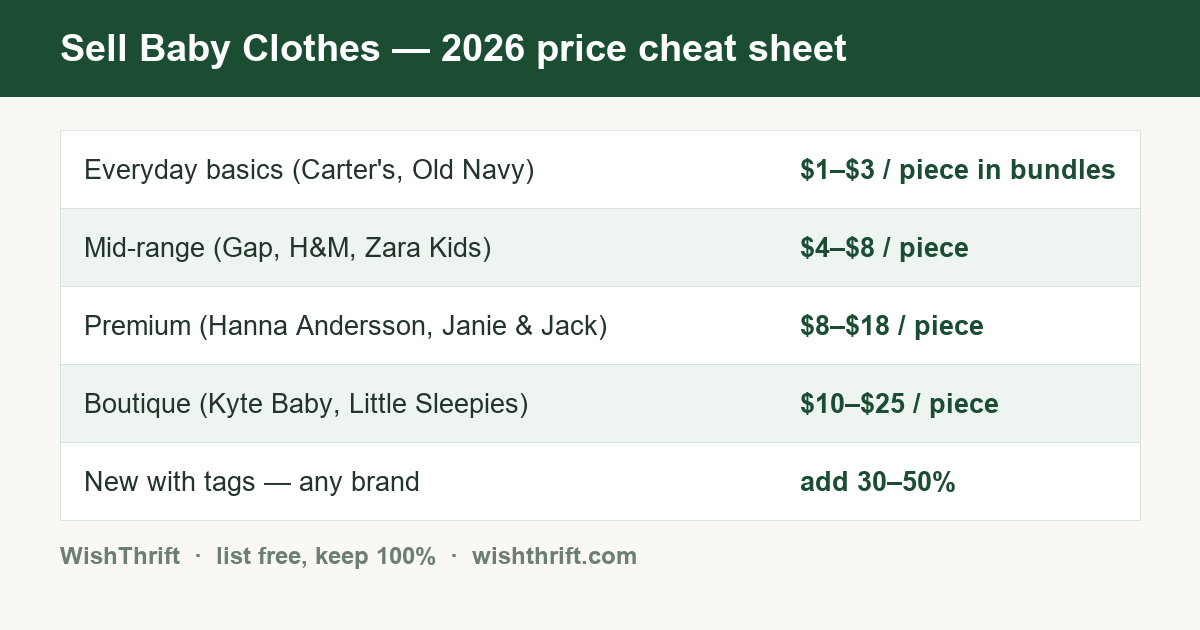
What baby clothes are worth in 2026
| Brand tier | Typical resale |
|---|---|
| Everyday basics (Carter’s, Old Navy, Gerber) | $1-$3 per piece, sold in bundles |
| Mid-range (Gap, H&M, Zara Kids) | $4-$8 per piece |
| Premium (Hanna Andersson, Janie & Jack, Mini Boden) | $8-$18 per piece |
| Boutique & organic (Kyte Baby, Little Sleepies, Bonpoint) | $10-$25+ per piece |
| New with tags, any brand | add 30-50% |
Boutique bamboo sleepers are the sleeper hit of the category – sought-after Kyte Baby and Little Sleepies prints hold value remarkably well, and rare prints can resell near retail. If you have those, always list them individually with the print name in the title.
Bundle strategy: the key to baby resale
Nobody buys one used Carter’s onesie; parents buy a size, for a season. Group basics into lots by size and season – “15-piece baby girl 6-9 month fall/winter bundle” – and price the lot at $25-$35. You clear a drawer in one sale, the buyer outfits a kid for a month, and one shipment replaces fifteen. Keep premium pieces out of bundles: a $16 Hanna Andersson dress disappears financially inside a $30 lot.
Where to sell baby clothes online
| Platform | Best for | Seller cost |
|---|---|---|
| WishThrift | Bundles and singles, any brand | No fee, keep 100% |
| Kidizen | Kids-only audience | ~12% + $0.50 per sale |
| Poshmark | Premium brands | $2.95 under $15, 20% over |
| Mercari | General audience | Fees have changed repeatedly – check current |
| Once Upon a Child | Instant cash, zero effort | Pays ~20-30% of resale value |
| Facebook Marketplace | Local bundle handoffs | Free, local only |
Fees as publicly listed in July 2026 – confirm current rates before pricing.
Fees hurt most exactly here, at low price points: on a $12 sale, Poshmark’s flat $2.95 is a quarter of your money gone. That math is why zero-fee listing matters more for baby clothes than for almost any other category.
Clear the outgrown drawer this weekend – list bundles free and keep every dollar.
Photos and listings that sell
Flat-lay everything on a plain white blanket in daylight. For bundles, shoot the whole lot arranged neatly, then close-ups of the best 3-4 pieces and every brand tag. Titles should read the way parents search: brand, gender, size, season – “Kyte Baby 6-12m bamboo zipper sleepers x3”. Note washing habits (“washed in free-and-clear detergent, smoke-free, pet-free home”) – it genuinely moves anxious first-time parents to buy.
Shipping
Baby clothes are the easiest shipping in resale: most single items ship in a poly mailer at the lightest USPS Ground Advantage tier, and even a 15-piece bundle usually stays under a few pounds. Weigh the packed bundle before setting a shipping price so you neither scare buyers off nor eat the cost. Our general guide to selling clothes online covers packaging in more depth.
What not to sell
Skip anything recalled (check the CPSC site for gear), used car seats past their expiry, and drop-side cribs – regulated gear has rules clothes don’t. Stained or pilled clothing goes to donation or textile recycling, not into your listings; one bad piece in the photos drags down trust in everything else you sell. Shopping the other side? Browse pre-loved baby & kids items on WishThrift.
The baby resale calendar
Parents shop one season ahead, so list accordingly: fall/winter bundles move from late August through November, spring/summer from February through May. Coats, snowsuits and holiday outfits spike hard and early – a Christmas dress listed in November sells in days, the same dress in January waits a year. Off-season stock isn’t wasted, it’s inventory: photograph it when you pack it away and schedule the listings for the right window. The exceptions are sleepers and everyday basics, which sell steadily all year because babies grow on their own schedule.
Turn one buyer into a repeat buyer
Baby resale has a structural advantage no other category has: your buyer’s child will need the next size in about four months, and you probably have it. Mention it – “we have 12-18m from the same wardrobe, follow for the next batch” – and bundle generously when someone buys twice. A parent who trusts your washing habits and your honesty about stains will happily clear your next three drawers, and on a zero-fee marketplace every one of those repeat sales is pure return. This is exactly the flywheel our general selling guide describes, compressed into fast-growing sizes.
Finally, set expectations on wear honestly by age band: buyers know newborn clothes are nearly unworn and that 2T leggings have knees. Grade harshly, photograph generously, and your bundles will outsell prettier listings from harsher graders every time.
Your 10-minute pre-listing checklist
Before a bundle goes live, run it through this once: every piece washed and checked under daylight for stains you missed indoors; snaps, zips and elastic all working; pieces counted and the count stated in the title; sizes confirmed from the actual tags, not memory, because a “6-9m” bundle with a stray 12m piece earns a complaint; the best three pieces photographed individually; brand names spelled correctly for search (it is “Hanna Andersson”, not “Hannah”); season named in the title; your washing routine and smoke/pet status in the description; shipping weight measured with the mailer on the kitchen scale; and the price checked against one comparable sold bundle, not an asking price. Ten minutes of this turns a “maybe” listing into one that sells the same week – and builds the trust that brings the same parent back for the next size up.
FAQ: selling baby clothes
Is it worth selling used baby clothes?
Yes, if you bundle. Basics fetch $1-$3 a piece in size-and-season lots, and premium brands $8-$25 individually – a typical outgrown wardrobe returns $50-$200. On a zero-fee marketplace all of it stays with you.
What baby clothes sell best?
Boutique bamboo sleepers (Kyte Baby, Little Sleepies), premium brands like Hanna Andersson and Janie & Jack, coats and shoes in bigger kid sizes, and clean seasonal bundles listed just before the season starts.
How should I price a baby clothes bundle?
Count the pieces, value basics at $1.50-$2.50 each depending on condition, and round to a clean number – a 15-piece bundle at $25-$35 is the sweet spot that moves fast without giving the lot away.
Do Carter’s baby clothes have resale value?
Individually, very little – but in clean, well-photographed size bundles they absolutely sell, at $1-$3 per piece. Carter’s is the volume play of baby resale, not the margin play.
Item-by-item guides
Detailed guides for specific items, each covering what it is worth, the photographs that sell it, what to put in the title and the questions buyers will send you:
- How to sell baby bouncer — £12 to £50
- How to sell baby carrier — £15 to £70
- How to sell baby grow — £3 to £15
- How to sell baby monitor — £20 to £90
- How to sell baby walker — £10 to £45
- How to sell breast pump — £20 to £90
- How to sell car seat — £30 to £150
- How to sell changing table — £25 to £110
- How to sell cot — £40 to £200
- How to sell cot bed — £50 to £250
- How to sell high chair — £20 to £90
- How to sell moses basket — £15 to £60
- How to sell nursery furniture — £40 to £250
- How to sell pram — £50 to £300
- How to sell sterilizer — £10 to £45
- How to sell stroller — £40 to £250
- How to sell travel system — £80 to £400
Maya Chen is Senior Editor at WishThrift, where she writes about the global secondhand market, sustainable shopping, and the resale economy. Her work focuses on practical buyer guides — designer authentication, online thrift tactics, used-book hunting, and what to look for on every listing before you pay. She edits the WishThrift seller knowledge base and reviews every guide published on the site.