
A real Chrome Hearts beanie starts around $300 at retail, resells secondhand for roughly $150 to $800 depending on fabric and style, and is one of the most counterfeited accessories in streetwear. Before you buy — or before you price one you found — you need exactly four checkpoints: the interior label, the embroidery quality, the leather patch work, and simple price logic. This guide walks through each, gives realistic 2026 secondhand values, and explains how to buy or sell one safely on a peer-to-peer marketplace.
- Retail starts around $300; cashmere and collab styles run far higher, so a cheap “new” Chrome Hearts beanie is a fake by definition.
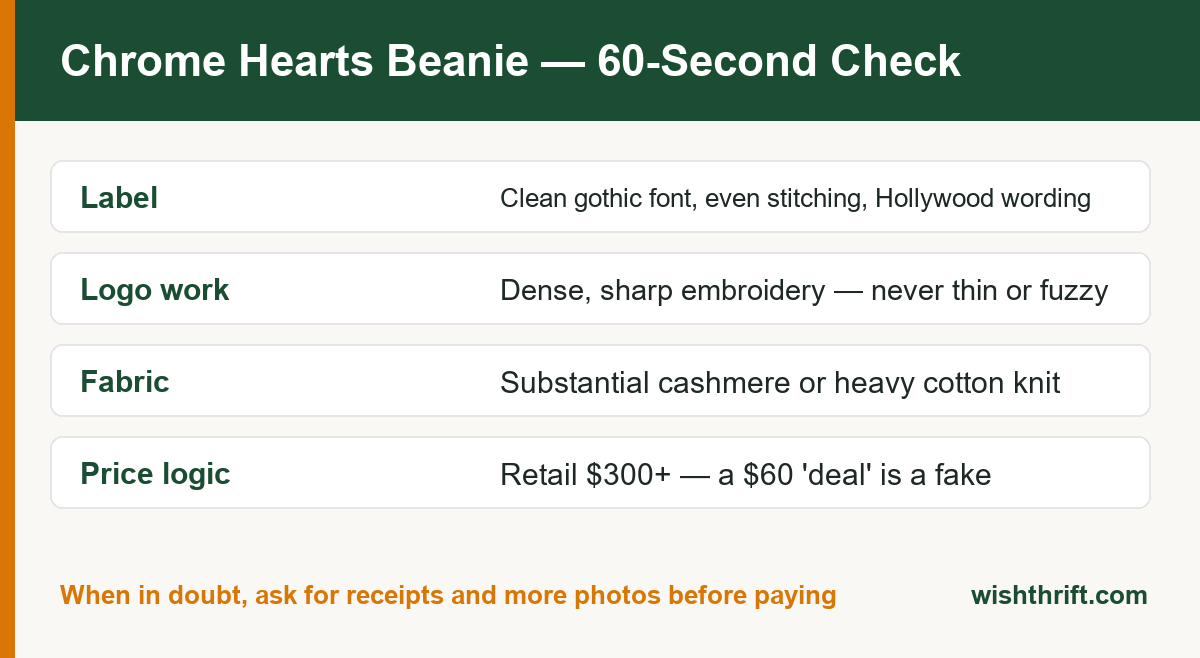
- The four fastest tells: sloppy interior label, thin or fuzzy logo embroidery, poor leather-patch stitching, and too-good pricing.
- Secondhand values in 2026: roughly $150–$400 for standard knits, $400–$800+ for cashmere and sought-after collaborations.
- Buy only from sellers who show the interior label up close — it is the hardest element for counterfeiters to get right.
Why the Chrome Hearts Beanie Is Everywhere
Chrome Hearts started in Los Angeles in 1988 as Richard Stark’s leather and sterling-silver workshop, and for decades it stayed a rock-and-roll jeweller. The 2020s changed that: constant celebrity wear, the Y2K silver-jewellery revival and a strict no-discount, limited-distribution model turned the gothic cross into one of fashion’s strongest status symbols. The beanie became the entry ticket — one-size, unisex, instantly recognisable, and the cheapest item in the store that still says Chrome Hearts. Massive demand plus a $300+ price floor is a formula counterfeiters cannot resist, which is why most “Chrome Hearts” knit hats on general marketplaces are not real.
Real vs Fake: The Four Checkpoints
1. The interior label
The woven label is where most fakes die. On authentic hats the gothic lettering is crisp and evenly spaced, the label is stitched in straight and square, and the wording is consistent with the brand’s Los Angeles/Hollywood origins. Counterfeit labels show blurry letterforms, uneven kerning, wavy stitching or spelling and formatting that does not match any verified example. Because label formats have varied over the years, the practical method is comparison: put the seller’s label photo next to a verified example of the same style and era and look for differences in font weight and spacing.
2. Embroidery density
Authentic logo embroidery — script logos, crosses, dagger motifs — is dense, raised and sharp-edged, with high stitch counts that feel almost solid under your thumb. Fakes economise here: thin fill, visible backing fabric between stitches, fuzzy outlines and threads that pull loose. If a close-up photo makes the embroidery look flat or sparse, pass.
3. Patch and construction quality
Styles with leather cross patches should use thick, quality leather attached with tight, even stitching that matches the hat’s overall standard. Check the fold of the cuff, the seam inside the crown and the way the patch corners sit. A genuine $300 knit hat is finished like one; glue residue, crooked patches or loose seam ends are immediate disqualifiers.
4. Fabric and price logic
Chrome Hearts knits are substantial — heavy cotton or noticeably soft, dense cashmere. Thin, scratchy acrylic is a replica hallmark. Then apply the simplest filter of all: nobody sells a real one new for $60. Deep “deals” from sellers with no history, stock photos or vague answers are the counterfeit distribution channel working as designed.
Chrome Hearts Beanie Prices Secondhand (2026)
| Style | Typical secondhand price | Notes |
|---|---|---|
| Standard logo knit, good condition | $150–$400 | Most common entry point; colour and logo style move the price |
| Cashmere styles | $400–$800+ | Feel and drape are unmistakable next to acrylic fakes |
| Collaborations & rare colourways | $500–$1,000+ | Matty Boy artwork and limited drops carry premiums |
| Worn, pilled or stretched | $100–$180 | Still sells — the label carries it — but disclose honestly |
Prices are directional for mid-2026; hyped drops move fast. If a listing sits far below these bands, the discount is the warning.
Buying One Secondhand Without Getting Burned
Ask every seller for three photos: the interior label straight-on, a macro shot of the embroidery or patch, and the hat on a flat surface showing its shape. Ask where it was bought and whether receipts or the original pouch exist — real owners answer specifics readily, while fake sellers deflect. Favour platforms where you can message the seller directly and check their history and ratings; on WishThrift every seller has a public profile with ratings and a verified seller programme, and messaging is built in. For the broader method that applies to any luxury item, read our guide on how to spot fake designer items before you spend.
Selling a Chrome Hearts Beanie
If you own a real one, you are holding one of the most liquid items in streetwear. Photograph the exact checkpoints buyers fear — label, embroidery macro, patch stitching — state where you bought it, and price inside the table above for a fast sale or 10–15% over for patience. On a zero-fee marketplace you keep the entire sale price: on a $350 beanie, that is roughly $40–$50 saved versus typical resale-app fees. List it free here, or read our guide to selling designer pieces for pricing psychology that gets luxury items sold in days rather than months.
Caring for the Knit
Hand wash cold with wool or cashmere shampoo, press water out in a towel, and dry flat away from heat — never hang a wet knit or machine-dry it. Store folded, and shave pilling with a fabric comb rather than pulling it. A well-kept cashmere beanie holds its resale band for years, which makes care a financial habit as much as a cosmetic one.
FAQ: Chrome Hearts Beanie
How much does a real Chrome Hearts beanie cost?
At retail, Chrome Hearts knit hats generally start around $300 and climb well past $500 for cashmere and special collaborations. Secondhand, expect roughly $150 to $400 for standard logo knits in good condition and $400 to $800 or more for cashmere styles and sought-after collabs. Anything offered new for $50 to $80 is a replica.
How can I tell if a Chrome Hearts beanie is fake?
Check four things: the interior woven label should show clean, evenly stitched gothic lettering; logo embroidery should be dense and sharp rather than thin or fuzzy; leather cross patches should be thick leather with tight, even stitching; and the knit itself should feel substantial. Fakes usually fail at least two of these at once, and an unrealistic price fails the test on its own.
Does Chrome Hearts make its products in the USA?
Yes. Chrome Hearts has manufactured in the United States since Richard Stark founded the brand in Los Angeles in 1988, and its labelling reflects its Hollywood base. Wording and label formats have varied across years and product lines, which is why you compare any specific beanie against verified examples from the same era rather than one universal template.
Is a Chrome Hearts beanie worth it secondhand?
If you want the brand, secondhand is the sensible entry point: knit hats are one of the cheapest ways into Chrome Hearts, they are unisex and one-size, and buying used typically saves 30 to 50 percent against retail. The catch is the fake rate — only buy from sellers who provide detailed label photos and ideally proof of purchase.
Maya Chen is Senior Editor at WishThrift, where she writes about the global secondhand market, sustainable shopping, and the resale economy. Her work focuses on practical buyer guides — designer authentication, online thrift tactics, used-book hunting, and what to look for on every listing before you pay. She edits the WishThrift seller knowledge base and reviews every guide published on the site.