



Authentic Balenciaga slides resell for $150–$300 in lightly worn condition in 2026 — against a retail price that has sat around $400–$500 — and the market beneath them is crowded with some of the most-produced fakes in luxury footwear. Whether you are buying a pair or selling one from the wardrobe, the same few checkpoints decide the deal: logo typography, mould quality, interior markings, price logic. This guide runs through them, prices every condition tier honestly, and gives sellers the listing formula that closes designer footwear fast.
- 2026 resale: $150–$300 lightly worn, more new-in-box, $80–$150 with visible wear.
- Fakes fail on typography first: letterform weight and spacing in the printed logo are the fastest tell.
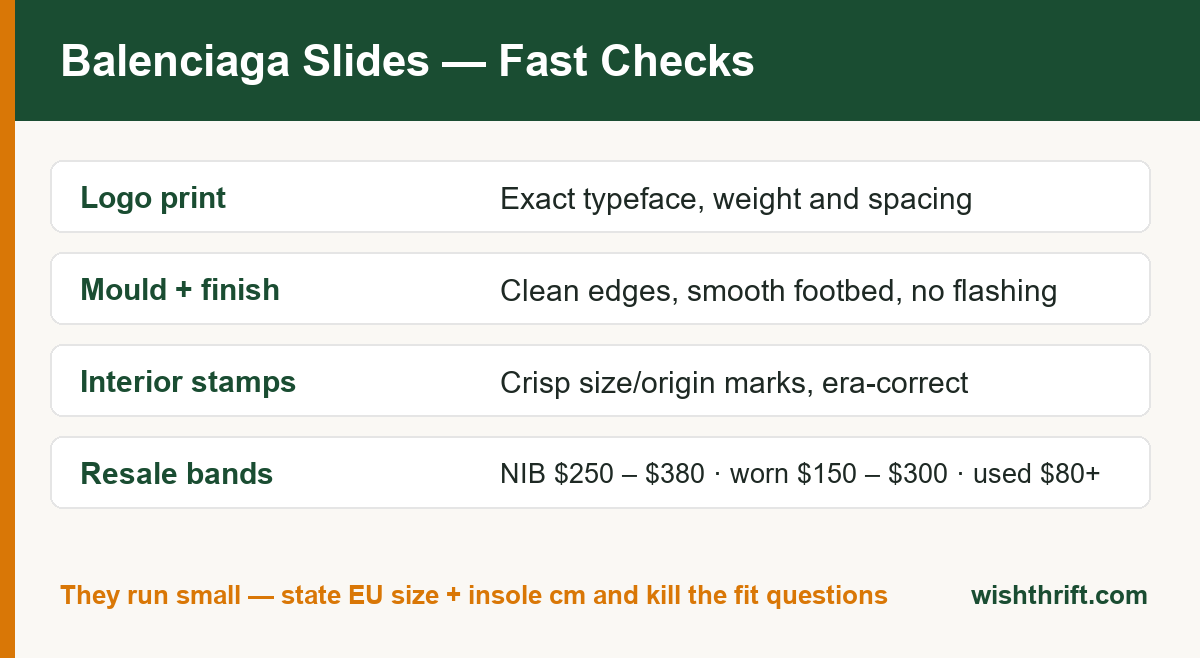
- They run small and buyers know it — state the printed EU size plus insole length and kill the fit questions.
- High liquidity, light shipping, strong margins: slides are one of the easiest designer resale categories.
Why Slides Became a Resale Staple
Balenciaga put a plain pool slide into luxury pricing and the market said yes: the logo did the work, the comfort did the rest, and the style became a wardrobe default for a generation of streetwear and luxury buyers alike. Resale followed naturally — slides are unisex, easy to photograph, cheap to ship and simple to condition-grade, which makes them one of the most liquid items in designer footwear. It also made them a counterfeiter’s dream: a simple moulded shoe with a printed logo is far easier to fake than a constructed sneaker, so replica volume is enormous and the authentication burden falls on photos and detail checks.
Real vs Fake: The Checkpoints
- Logo typography. The printed BALENCIAGA is the brand’s own exercise in precision: exact typeface, consistent stroke weight, correct letter spacing, clean edges. Replicas are subtly off — usually in spacing and weight — and comparison against verified photos of the same colourway settles it fast.
- Mould and finish. Real pairs come out of clean moulds: even edges, no flashing or rough seams, smooth uniform footbed texture. Bubbling, rough mould lines or gritty surfaces fail the pair.
- Interior markings. Size, origin and branding stamps inside the shoe should be crisp, correctly placed and era-consistent. Shallow, smudged or oddly positioned stamps are a standard replica failure.
- Box, dust bag and price logic. Packaging is faked too, so treat it as supporting evidence only — and let price logic run last and loudest: nobody sells real pairs new at half retail from a no-history account.
The method generalises across the category — our fake designer guide covers the discipline, and our sneaker resale guide maps the adjacent market where the same buyers shop.
Resale Prices by Condition (2026)
| Condition | Typical resale | Notes |
|---|---|---|
| New in box, current colourways | $250–$380 | Best liquidity in core black and white |
| Lightly worn, clean footbed | $150–$300 | The volume tier — most wardrobe pairs land here |
| Visible wear (footbed impressions, sole wear) | $80–$150 | Sells honestly graded; photograph the wear plainly |
| Heavy wear or damage | $40–$80 | Still moves at look-for-less prices |
Bands are directional for mid-2026. Popular sizes in core colours sell fastest; unusual colourways trade slower but sometimes higher to the right buyer.
The Seller’s Listing Formula
Designer footwear listings live or die on five photos and two facts. The photos: top-down pair shot, logo macro, footbed close-up (honesty about wear lives here), soles, and interior size stamp. The facts: the printed EU size plus a note that the style runs small, and the insole length in centimetres. That combination answers authenticity and fit — the only two questions buyers actually have — before they message you. Clean the pair first: mild soap and a soft brush on the moulded surfaces, air dry, never machine-anything. Price inside the condition tier for a fast sale; slides are a liquidity category, and the seller who prices to move this week beats the one anchored to retail nostalgia.
Grading Condition Honestly: The Ladder That Sells
Moulded footwear is the easiest category in fashion to grade — and mis-grading is still the top cause of returns, so learn the ladder and use its language. New in box means unworn with packaging, nothing less. Like new means worn indoors a handful of times: no footbed impression visible at an angle, no sole scuffing beyond faint texture. Lightly worn — the tier most wardrobe pairs honestly occupy — means a visible but shallow footbed impression and light sole wear, no edge damage. Worn means deep impressions, sole wear into the tread pattern, possible discolouration; photograph all of it plainly. The discipline pays twice: accurate grading eliminates disputes, and buyers who have been burned elsewhere pay a premium to sellers whose photos match the words. When in doubt, grade one step harsher than you believe — the pleasant surprise on arrival is what turns a first buyer into a repeat one, and repeat buyers are how casual sellers quietly clear a whole wardrobe.
Keep Every Dollar of a Thin-Margin Sale
Fees hurt most where margins are modest: a $180 slide sale loses $20–$30 to typical platform commission and payment charges — a real slice of the profit on a shoe you bought at retail. On WishThrift, listing is free and commission is zero, so the price you set is the money you keep. If the wardrobe holds more than one hyped pair, our Jordan 1 guide and selling shoes online guide cover the rest of the shoe shelf with the same playbook.
FAQ: Balenciaga Slides
How much do Balenciaga slides resell for?
In 2026, authentic pairs in clean, lightly worn condition typically resell for $150 to $300 — roughly a third to two-thirds of their recent retail, which has sat in the $400-$500 range. New-in-box pairs of current colourways bring more; visibly worn pairs with footbed impressions and sole wear drop to $80 to $150. Colourway and size liquidity move prices within the bands.
How can I tell if Balenciaga slides are fake?
Check the logo first: the printed BALENCIAGA should match the era’s exact typeface, weight and spacing — fakes get letterforms subtly wrong, especially spacing. Then inspect moulding and finish: real pairs have clean, even edges, smooth footbeds and precise interior size and origin markings; replicas show rough mould lines, bubbling or shallow stamps. Smell and flex are supporting tells — cheap rubber compounds announce themselves. Finally, price logic: heavily discounted ‘new’ pairs from unknown sellers are replicas.
Do Balenciaga slides run true to size?
They are generally known to run small, and most buyers size up — a fact worth stating in any listing because fit questions are the number-one message sellers receive. State the EU size printed on the shoe plus the insole length in centimetres if you can measure it; that single line answers most sizing doubts and reduces returns and disputes.
Is it worth selling used designer slides?
Yes — condition-graded honestly, there is a real market at every tier. Lightly worn pairs keep most of their value because buyers happily save $200+ against retail, and even worn pairs sell to buyers who want the look cheaply. The category’s liquidity is high, the shipping is easy, and on a fee-free marketplace the margins stay yours.
Maya Chen is Senior Editor at WishThrift, where she writes about the global secondhand market, sustainable shopping, and the resale economy. Her work focuses on practical buyer guides — designer authentication, online thrift tactics, used-book hunting, and what to look for on every listing before you pay. She edits the WishThrift seller knowledge base and reviews every guide published on the site.
1 thought on “Balenciaga Slides: Real vs Fake, Resale Prices & Selling Guide 2026”
Comments are closed.