



Women’s ReRock jeans are from ReRock for Express — the in-house denim line the US mall retailer Express ran during the late 2000s and early 2010s, and later quietly discontinued. If you have just pulled a pair out of a thrift rack or a storage box and searched the label, here is the short answer: they are genuine 2000s-era mall denim, they are no longer made, and in 2026 they typically resell for between $8 and $45 depending on style and condition. This guide covers how to identify them, what each style is worth, and how to buy or sell a pair without guesswork.
- ReRock was Express’s own denim label, sold roughly 2007–2014 and now discontinued — every pair is secondhand.
- Typical resale in 2026: $8–$18 for plain pairs, $15–$30 for embellished-pocket styles, $25–$45 for deadstock with tags.
- Identify them by the “ReRock for Express” branding on the interior waistband tag and the era’s heavy contrast stitching.
- Sizing runs small by modern standards — always buy and sell by flat waist measurement, not the tag number.
What Are ReRock Jeans?
ReRock for Express was the denim sub-brand Express used to compete with the big 2000s mall-denim players — think the same shopping trips that produced True Religion, Miss Sixty and embellished-pocket Guess pairs. The line covered men’s and women’s fits, but the women’s ReRock jeans are what surface most often in thrift stores today: low and mid-rise skinny, bootcut and flare cuts in dark indigo and sandblasted washes, usually cotton with a small percentage of spandex for stretch.
The house signatures were loud by today’s standards: thick tan or gold contrast stitching, whiskering across the hips, faded thighs, and back pockets decorated with heavy seams, studs, buttons or rhinestone details. That styling dates a pair instantly — which in 2026 is precisely why people want them.
Why Women’s ReRock Jeans Are Suddenly Searched Again
Three things are driving the revival. First, the Y2K and late-2000s trend cycle has moved from micro-trend to mainstream, and “indie sleaze” dressing pulled 2008–2012 mall fashion back with it. Second, ReRock is discontinued, which turns an ordinary pair of jeans into a small piece of archive denim — you cannot walk into an Express store and buy the look new. Third, thrift stores across the US are full of them, because millions of pairs were sold and donated. That combination of nostalgia, scarcity of production and abundance of supply makes women’s ReRock jeans one of the easiest low-stakes flips in secondhand denim right now.
How to Identify a Real Pair
You do not need authentication skills for a mall brand, but you do need to recognise the tags, because the wash-label branding is often the only place “ReRock” appears:
- Interior waistband tag: should read “ReRock for Express” or carry ReRock branding alongside Express sizing.
- Leather-look patch: many pairs carry an embossed patch on the back waistband with ReRock or Express branding.
- Hardware: branded shanks and rivets were standard — blank hardware on a supposedly embellished pair suggests heavy repair or a mislabelled listing.
- Construction era: expect stretch denim, low or mid rise, and busy back pockets. A high-rise rigid pair with a ReRock tag would be a mismatch worth questioning.
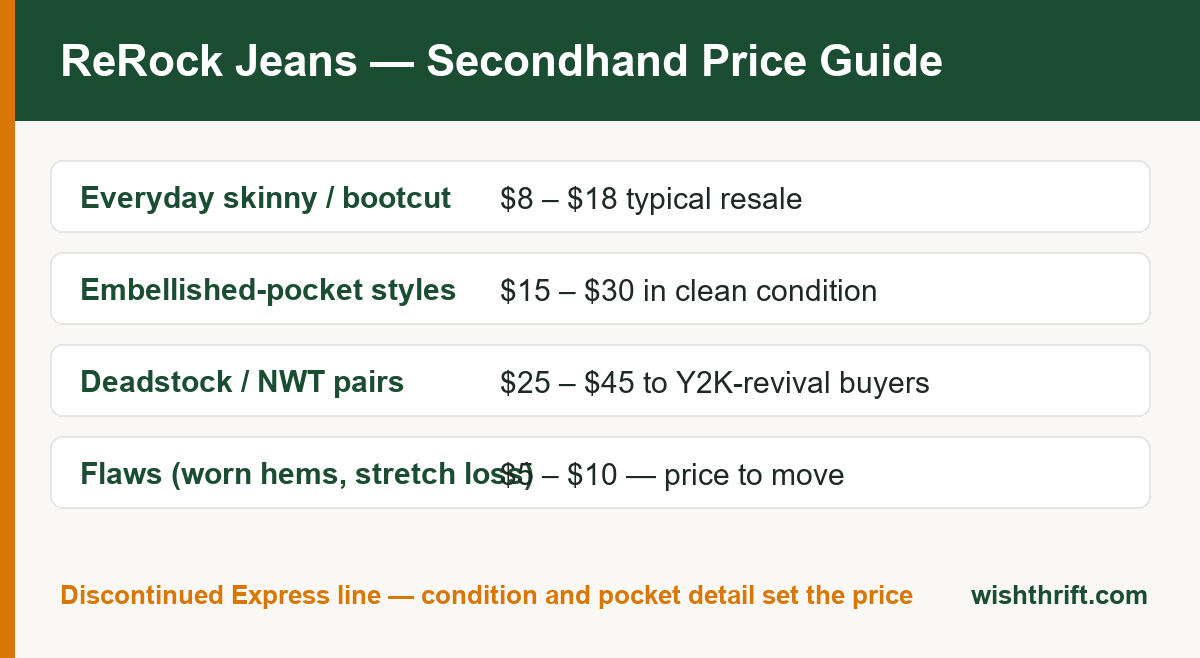
Women’s ReRock Jeans Price Guide (2026)
Prices below reflect what pairs actually change hands for on peer-to-peer marketplaces in 2026, not optimistic asking prices:
| Style / condition | Typical resale | Notes |
|---|---|---|
| Plain skinny or bootcut, good used condition | $8–$18 | The bulk of the market; price to sell within days |
| Embellished or flap-pocket styles | $15–$30 | Studs, rhinestones and heavy stitching lift demand |
| Flares and less common cuts | $15–$28 | Fewer survived; flare revival helps |
| New with tags / deadstock | $25–$45 | Y2K-revival buyers pay for untouched pairs |
| Worn hems, stretched fabric, repairs | $5–$10 | Sell honestly described or bundle |
The single biggest price lever is condition of the stretch fabric. Spandex degrades: a pair that has gone baggy at the knees and seat will disappoint a buyer even if it photographs well, so check recovery by stretching a leg panel and watching whether it springs back.
Sizing: Ignore the Number, Measure Everything
ReRock used late-2000s vanity sizing, and fifteen years of washing changes stretch denim further. Whether you are buying or selling, work from four flat measurements: waist across the top, hips at the widest point, front rise, and inseam. As a rule of thumb, a modern size 6 buyer often fits a ReRock 8 or even 10, and low-rise cuts sit two to three inches below where current mid-rise jeans sit — a genuine surprise if you have not worn 2000s denim before.
How to Style Them in 2026
The current way to wear women’s ReRock jeans is to lean into the era rather than fight it: bootcuts with a fitted baby tee and a slouchy shoulder bag, or the skinny cut tucked into boots under an oversized leather jacket. If the wash feels too heavy, the whiskered light-blue pairs read perfectly as “borrowed from 2009” with a plain white tank. For more on assembling the look from thrifted pieces, see our Y2K fashion guide and downtown girl aesthetic guide.
Selling a Pair? Here Is the Playbook
Photograph the waistband tag, the back pockets and the leather patch — those three shots answer every buyer question about authenticity and era. State all four measurements, name the fabric content from the care label, and mention the discontinued-line angle in your title: “ReRock for Express” plus the cut plus the size is exactly what buyers type. Since these are volume items, price inside the ranges above and your pair will move quickly. You can list them free on WishThrift — no seller fees on any sale, which matters on a $15 item where a 10% platform cut plus payment fees would eat the profit. Our guide to the best things to resell for profit explains why discontinued mall denim is such a reliable small flip.
FAQ: Women’S Rerock Jeans
Are ReRock jeans still made?
No. ReRock was a denim line sold by Express, mainly through the late 2000s and early 2010s, and it has since been discontinued. Every pair you see today is secondhand or old deadstock, which is exactly why the label now reads as a period piece of 2000s mall fashion.
How much are women’s ReRock jeans worth?
Most women’s ReRock jeans resell for roughly $8 to $18 in worn condition. Clean pairs with the heavily stitched or embellished back pockets typically bring $15 to $30, and new-with-tags deadstock can reach $25 to $45 from Y2K and 2010s-revival buyers. Damaged pairs with stretched-out fabric usually sell under $10.
Do ReRock jeans run small or large?
They tend to run smaller than modern sizing. ReRock pairs were cut in the low-rise, body-hugging style of their era and used stretch denim that can lose recovery over time. Ignore the number on the tag and go by the flat waist and hip measurements, which honest secondhand listings should always include.
Are ReRock jeans good quality?
They were a mid-range mall brand: mostly cotton with a few percent spandex, heavy contrast stitching and decorative hardware. They are not premium selvedge denim, but surviving pairs have already proved they can take 15 years of wear, and the aesthetic is the point for buyers chasing an authentic 2000s look.
Maya Chen is Senior Editor at WishThrift, where she writes about the global secondhand market, sustainable shopping, and the resale economy. Her work focuses on practical buyer guides — designer authentication, online thrift tactics, used-book hunting, and what to look for on every listing before you pay. She edits the WishThrift seller knowledge base and reviews every guide published on the site.
1 thought on “Women’s ReRock Jeans: What They Are & What They’re Worth in 2026”
Comments are closed.