



Every vintage gold watch conversation starts with one question: solid gold or plated? Solid gold pieces carry a hard value floor — the melt value of the case metal — plus whatever the brand and model add on top, while plated watches sell on style alone at $30–$150. The answer is usually stamped inside or on the case in a hallmark you can read in seconds. This guide shows you how to read it, what every tier of vintage gold watch is worth in 2026, and how to sell yours safely for the most it will bring.
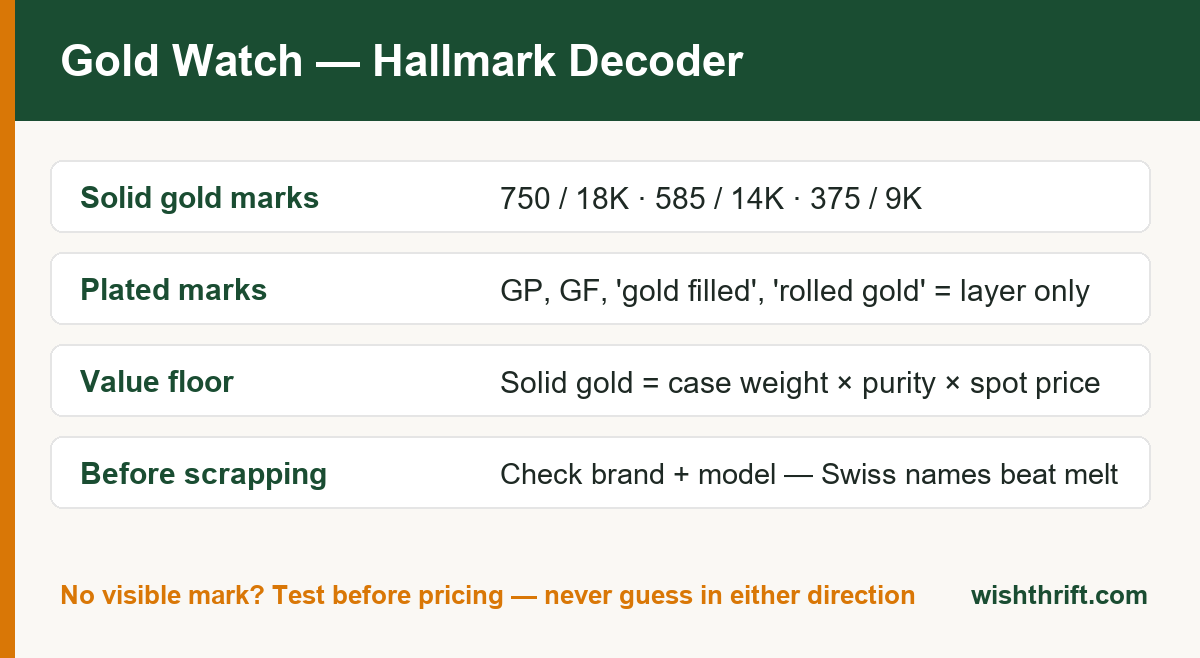
- Hallmarks decide everything: 750/18K, 585/14K and 375/9K mean solid gold; GP, GF and ‘plated’ marks mean a gold layer over base metal.
- Solid gold watches have a melt-value floor a jeweller can calculate in minutes — know it before you price.
- Recognised Swiss brands can be worth several times melt; never scrap a watch before checking the name and model.
- Don’t service before selling — describe running state honestly; buyers budget for servicing.
Step One: Find and Read the Hallmark
Check the case back (outside and, if it opens easily, inside), the lugs and the clasp. Solid gold watches are marked with purity: 750 or 18K, 585 or 14K, 375 or 9K, often alongside national assay marks on European pieces. The other family of marks tells the opposite story — ‘gold plated’, ‘plaqué’, ‘GP’, ‘gold filled’, ‘GF’, ‘rolled gold’ and fraction marks like 1/20 12K GF all mean a gold layer over base metal, which carries sentimentality but almost no metal value. Two warnings: an unmarked case is not necessarily plated (some older cases lost marks to polishing — test before assuming), and a marked case is not necessarily honest (fake marks exist on fake watches — the brand checks below still apply).
Valuing Solid Gold: Floor Plus Name
A solid gold watch is worth whichever is greater: its metal or its name. The metal floor is straightforward — case weight times purity times the day’s gold price, which any jeweller will calculate for free — and with gold prices at historic strength in the mid-2020s, that floor alone often surprises people. The name is where the multiples live: recognised Swiss houses — Omega, Longines, Jaeger-LeCoultre, Rolex and their peers — carry collector markets where the right model in original condition is worth several times its melt. The expensive mistake in this market is scrapping first and researching never: dealers buy estate gold watches by weight precisely because sellers skip the model lookup. Search the brand, the dial text and any reference number engraved on the case before you accept any weight-based offer.
What Each Tier Sells For (2026)
| Tier | Typical resale | Notes |
|---|---|---|
| Gold-plated vintage, working | $30–$150 | Sells on style, size and running order |
| Solid gold, unremarkable brand | Melt value + 10–30% | The case is the value; dress watches from the 40s–70s dominate |
| Solid gold, recognised Swiss brand | 2–5× melt and up | Model and originality set the multiple — research before selling |
| Not running / needs restoration | Tier price minus 30–60% | Honest ‘for restoration’ listings still sell well |
| Ladies’ cocktail watches, solid gold | Near melt | Huge supply, small collector market — the metal is the price |
Bands are directional for mid-2026; gold’s spot price moves the floor daily, which is an argument for checking it the week you sell, not the year before.
Condition: What to Do and What to Leave Alone
Do nothing irreversible. Wipe the case gently, photograph it well, and stop — polishing softens the edges collectors pay for, amateur cleaning scratches dials, and both permanently subtract value. Don’t service before selling either: it rarely returns its cost, because vintage buyers budget for their own watchmaker. What does add value is information: whether it runs, roughly how it keeps time, whether the crown winds and sets smoothly, and a photo of the movement if the case back opens without force. Original boxes, papers and even old service receipts add real money — dig for them before listing.
The Inherited-Watch Question
Most vintage gold watches enter the market through inheritance, and that changes the calculus in two ways worth naming. First, information: relatives often know the story — where it was bought, when, whether it was serviced — and every fact of that provenance is sellable value, so ask before you list, and write what you learn into the description. Second, the decision itself: a watch worth near melt is an easy sale, but a watch worth several multiples of melt may also be worth keeping, insuring or splitting differently among family. The honest sequence is value first, decision second — hallmark, weight, brand and model research before anyone talks numbers. Selling a family piece at scrap weight because nobody ran a ten-minute lookup is the most common and most avoidable loss in this entire category.
Selling Safely and Keeping the Whole Price
Photograph the dial straight-on, the hallmarks in macro, the movement if accessible, and every flaw. Title with the facts buyers search: brand, metal purity, era, and running state — “Omega 14K solid gold dress watch, 1960s, running”. Ship tracked and insured, use payment with protection on higher-value pieces, and treat overpayment offers as the scams they are. Then mind the fees, because they scale brutally with price: a $400 watch loses $40–$60 on typical platforms, and more at consignment. On WishThrift you list free, pay no commission, and message buyers directly. The same hallmark-first logic applies to the rest of the jewellery box — our selling jewellery online guide covers the real-versus-costume tests, and our silver marks decoder does the same job for the flatware drawer.
FAQ: Vintage Gold Watches
How do I know if my vintage watch is solid gold or plated?
Look for hallmarks on the case back, lugs or inside the case back: solid gold carries purity marks such as 750 or 18K, 585 or 14K, and 375 or 9K. Marks like ‘gold plated’, ‘gold filled’, ‘GP’, ‘GF’ or ‘rolled gold plate’ mean a base-metal case with a gold layer. No visible mark means have it tested by a jeweller before you price or sell it — never guess in either direction.
What is a vintage gold watch worth?
Solid gold watches have a hard price floor: the melt value of the case, which a jeweller can calculate from weight and purity in minutes. On top of that, the brand and model add collector value — recognised Swiss names can be worth several times their metal. Gold-plated vintage watches typically sell for $30 to $150 on style and working order, since the gold layer itself carries almost no metal value.
Should I service a vintage watch before selling it?
Usually no. A service costs real money and buyers of vintage watches typically budget for their own servicing anyway. Describe the running state honestly instead: ‘running, keeps time’, ‘runs but gains minutes’, or ‘not running, sold for restoration’ are all sellable conditions at different prices. What you should do is photograph the movement if the case back opens easily — it is the photo serious buyers want most.
Is it safe to sell a gold watch online?
Yes, with basic discipline: photograph everything including hallmarks and movement, describe honestly, and for higher-value pieces use payment methods with seller protection and tracked, insured shipping. Deal through platforms where buyers can message you and you can see who you are talking to. Never hand over a watch against a promise of later payment, and be wary of overpayment offers — they are the classic watch scam.
Maya Chen is Senior Editor at WishThrift, where she writes about the global secondhand market, sustainable shopping, and the resale economy. Her work focuses on practical buyer guides — designer authentication, online thrift tactics, used-book hunting, and what to look for on every listing before you pay. She edits the WishThrift seller knowledge base and reviews every guide published on the site.
1 thought on “Vintage Gold Watches: What Yours Is Worth & How to Sell It Safely”
Comments are closed.