


Goyard bags occupy a strange corner of luxury: the house sells only through its own boutiques, never online, so the secondhand market is where most of the world actually buys them — and where most of the world’s Goyard fakes live. A genuine St. Louis tote trades from roughly $800 well past $1,500 in 2026, a convincing fake sells for a fraction, and the difference is readable in the canvas if you know what to look for. This guide covers the authentication checkpoints, realistic prices by style, and how to sell a genuine bag safely at its full value.
- Goyard (Paris, est. 1853) sells only via its own boutiques — the secondhand market is both essential and fake-heavy.
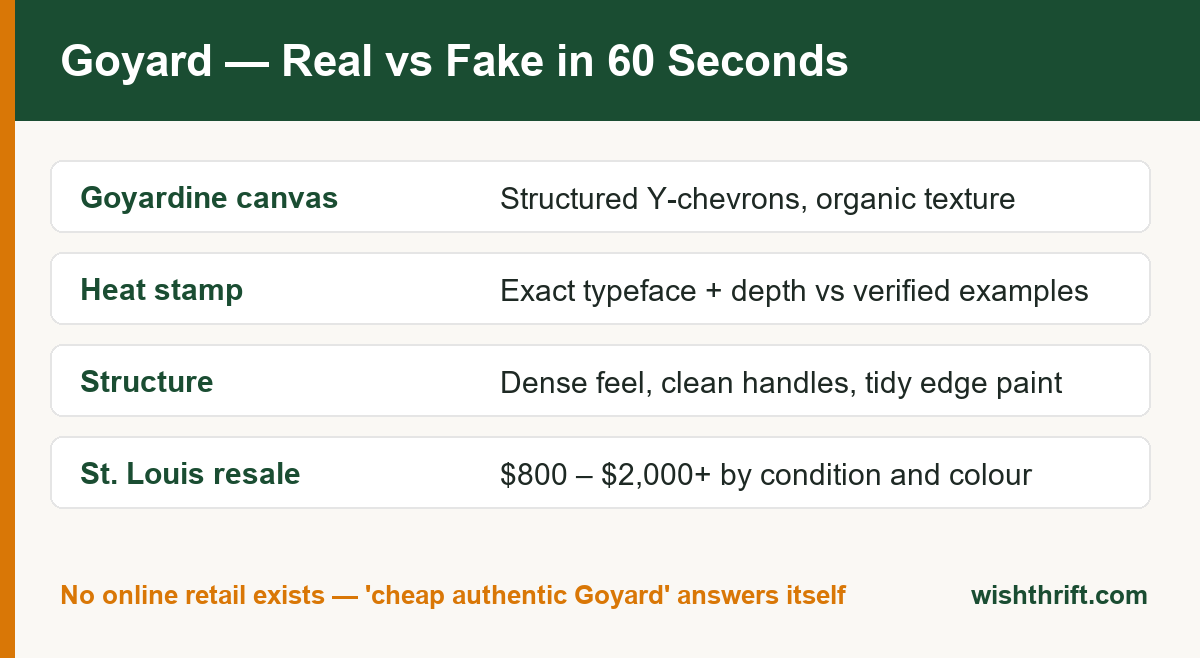
- The Goyardine canvas is the first check: structured Y-shaped chevrons with organic hand-applied texture; fakes print it flat.
- 2026 benchmarks: St. Louis tote roughly $800–$2,000+ by condition and colour; small leather goods from $300–$500.
- Selling: macro photos of canvas and heat stamp are your authentication — provenance details close the sale.
The Quietest Famous Brand in Luxury
Goyard has made trunks and bags in Paris since 1853, longer than almost anyone, and built its modern mystique on refusal: no e-commerce, no wholesale, minimal advertising, boutiques in a handful of cities. Scarcity did what marketing couldn’t — the chevron canvas became a status symbol precisely because you cannot simply order it — and the St. Louis tote became the entry bag of quiet luxury. Every part of that story feeds the secondhand market: buyers who can’t reach a boutique, owners sitting on appreciated bags, and counterfeiters serving everyone the house won’t. That is the market you are entering, from either side.
Real vs Fake: Reading the Goyardine
- The canvas pattern. Goyardine’s interlocking chevrons derive from a traditional hand-applied process: real canvas shows precisely structured Y-shapes, correctly spaced painted-style dots, and a slight organic texture you can see in raking light. Fakes print flat, with blurry dots, wrong proportions or patterns that misalign at seams and edges.
- The heat stamp. Typeface, spacing and stamp depth should match verified examples of the same era and style. Shallow, thick or crooked stamping fails the bag.
- Structure and weight. Real bags hold their shape and feel dense for their size; handles attach cleanly with even stitching and tidy edge paint. Floppy body, sloppy paint or plasticky handles are disqualifiers.
- Price logic. There is no such thing as cheap authentic Goyard — the house never discounts and demand always exceeds supply. A too-good price is the answer to the authentication question before you ask it.
When photos can’t settle it, walk — the method in our fake designer guide applies at full strength here, and with Goyard the canvas macro is the photo that decides everything.
Secondhand Prices by Style (2026)
| Style | Typical resale | Notes |
|---|---|---|
| St. Louis tote, visible use, classic colours | $800–$1,200 | The benchmark bag; corners and strap wear set the price |
| St. Louis, excellent condition / special colours | $1,500–$2,000+ | Colour rarity carries genuine premiums |
| Anjou, Artois and structured totes | $1,200–$2,500+ | Sturdier constructions trade above the St. Louis |
| Card holders, pouches, small goods | $300–$600 | The entry point — and the most casually faked tier |
| Heavy wear, repairs, personalisation | Tier minus 30–50% | Painted initials and stripes narrow the buyer pool |
Bands are directional for mid-2026. Goyard’s periodic retail price increases tend to pull the whole secondhand curve upward — worth checking the current boutique price before setting yours.
Selling a Goyard: Evidence, Then Price
At this price level your listing is an evidence file. Photograph the canvas in daylight at an angle that shows texture, the heat stamp in macro, the interior fully, the base corners, hardware, and every mark honestly. Write provenance into the description — which boutique, what year, receipt or gift — and say so plainly if you don’t know; secondhand-to-secondhand chains are normal for this brand and honesty reads as confidence. Personalised bags (painted initials and stripes are a Goyard tradition) should be photographed prominently since they narrow the market and price. Ship tracked and insured, insist on protected payment, and let serious buyers ask their questions — at four figures, responsiveness is your best negotiating position.
Buying Secondhand: Process Over Instinct
On the buying side, discipline replaces expertise. Insist on the three deciding photos — canvas macro in daylight, heat stamp close-up, interior — and treat any seller who won’t supply them as your answer. Compare against verified examples of the same style and colour rather than against memory; Goyardine’s details are exactly the kind the eye smooths over. Favour sellers with visible history and direct messaging, ask where and when the bag was bought, and note how the answer sounds — real owners answer in specifics, fake sellers in adjectives. On price, buy the bag, not the deal: a St. Louis at 40% under market from a fresh account is not a bargain, it is a checklist you skipped. And if a piece passes everything but still nags at you, pay for a professional authentication opinion — at these prices the fee is a rounding error against the downside.
Zero Fees Matter Most at Four Figures
Commission scales with price, which makes Goyard the worst place to give away 20%: consignment on a $1,500 St. Louis costs $300–$500, and even standard marketplace fees take $150+. On WishThrift you list free, pay no commission, and keep the entire price — the difference funds your next bag. Our selling handbags guide covers the full designer-bag playbook, and our Miu Miu guide applies the same method one brand over.
FAQ: Goyard Bags
Why are Goyard bags so hard to buy?
Goyard is one of the oldest Parisian trunk makers, founded in 1853, and it deliberately keeps distribution scarce: bags are sold through its own boutiques and select counters, not online and not wholesale. That scarcity strategy makes the brand quietly exclusive — and makes the secondhand market the only route for most buyers, which is exactly why counterfeiters flooded it.
How can I tell a real Goyard from a fake?
Start with the Goyardine canvas: the interlocking chevron-and-dot pattern derives from a hand-applied process, giving real canvas slight organic texture and precisely structured Y-shapes with correctly spaced dotting. Fakes print it flat, blurry or misaligned at seams. Then check the heat stamp’s typeface and depth, the structure and weight of the bag, handle attachment and edge finishing, and apply price logic — cheap ‘authentic’ Goyard does not exist.
How much is a secondhand Goyard St. Louis worth?
The St. Louis tote is the brand’s most common bag and the secondhand benchmark: in 2026, honest examples typically trade from around $800 for visibly used classic colours up to $1,500-$2,000+ for excellent condition, special colours and larger sizes. Other styles — Anjou, Artois, card holders and pouches — have their own bands, with small leather goods starting around $300-$500. Prices are directional; colour and condition move them substantially.
Is it safe to sell a Goyard bag online?
Yes, if your listing does the authentication work: photograph the canvas close enough to show its texture, the heat stamp in macro, the interior, the corners and any wear. State provenance — boutique, city, year, receipt if you have it. Use tracked, insured shipping and protected payment. Expect serious buyers to ask detailed questions; answering them quickly is what converts at this price level.
Maya Chen is Senior Editor at WishThrift, where she writes about the global secondhand market, sustainable shopping, and the resale economy. Her work focuses on practical buyer guides — designer authentication, online thrift tactics, used-book hunting, and what to look for on every listing before you pay. She edits the WishThrift seller knowledge base and reviews every guide published on the site.