
The RN number on a clothing tag is a Registered Identification Number issued by the US Federal Trade Commission, and it does two immediately useful things: it names the actual company behind any garment made or sold in the US, and — because the numbers are issued sequentially — it sets the earliest possible era the piece could date from. Both checks are free and take about a minute, which makes the RN the most underused tool in vintage buying and selling. This guide covers how to look a number up, how to read the result correctly, and how sellers use it to identify, date and price with confidence.
- RN = Registered Identification Number, issued by the FTC; it identifies the responsible company, free to look up in the FTC’s public database.
- Sequential issue means the RN bounds the earliest era — but companies keep their number forever, so it never dates a garment alone.
- A WPL prefix predates the RN series and is a strong mid-century vintage signal on its own.
- For sellers, the RN turns mystery tags into named brands and turns ‘old shirt’ listings into dated, priced vintage.
What the Number Actually Is
US labelling law requires textile, wool and fur products sold in the country to identify the responsible business — either by its full name or by its RN. Companies register once with the FTC and use the number on everything thereafter, which is why the same RN appears across decades of a brand’s products and across lines that carry different marketing names. That last part is the practical magic: licensed products, department-store house brands, and designers who manufacture through a parent company all reveal their real corporate identity through the RN. A tag whose brand name means nothing to you often carries a number that resolves, in one search, to a company you know very well — the trick behind identifying who really made a mystery garment, including cases like Marciano tags resolving to the Guess corporate family.
How to Run a Lookup
Three steps, no account, no cost:
- Find the number. It is on the brand tag or care tag, formatted like RN 12345. WPL numbers appear the same way on older garments.
- Search the FTC database. The commission’s public RN lookup returns the registered company name, and often its address and business type — enough to identify the maker outright.
- Add the collector layer. Search the web for the RN in quotes. Vintage forums and dating guides have documented thousands of numbers, and their notes on tag designs by era frequently pin a garment tighter than the database alone.
Using RN Ranges to Date — Properly
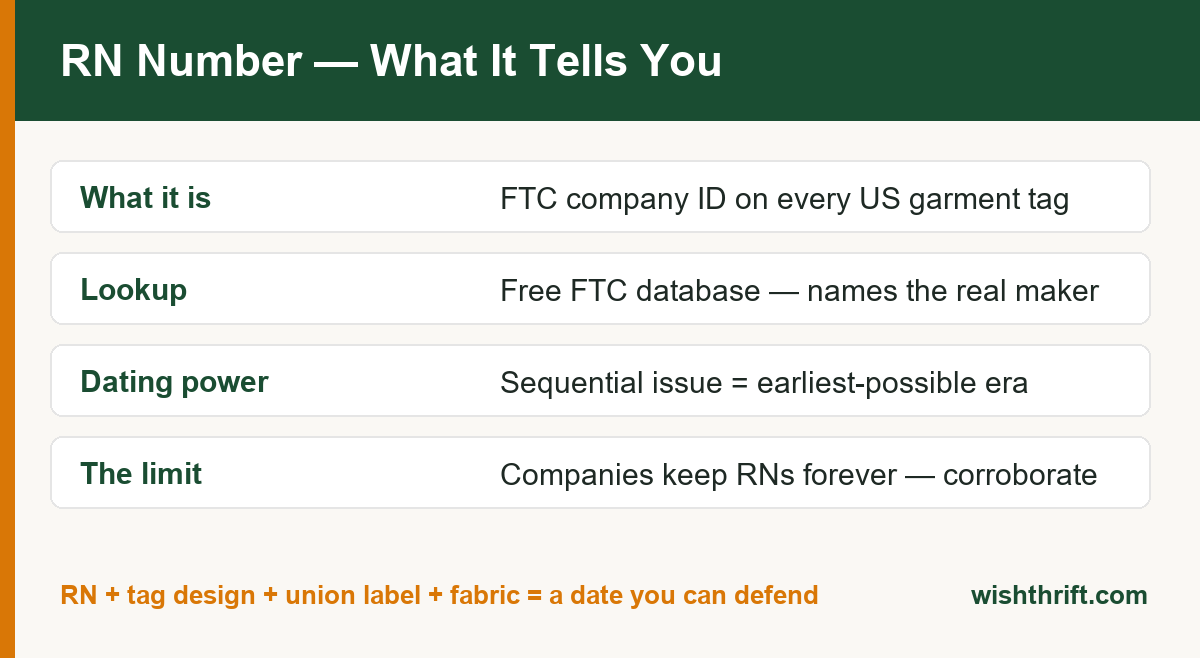
Because RNs are issued in sequence, vintage communities maintain approximate charts matching number ranges to issue years. Used correctly, the chart answers one question: what is the earliest this garment could be? A company holding a number issued in the mid-80s cannot have produced your supposed 70s piece — claim settled, argument over. Used incorrectly, the chart misdates constantly, because the company keeps its RN forever: a number issued in 1962 appears on garments made in 1962 and in 2022 alike. So treat the RN as one witness among several and corroborate with the physical evidence — tag design and typography (brands redesigned labels every few years, and collectors have documented the sequences for major names), union labels like the ILGWU tag that place manufacture in the American union era, fabric content and care-instruction formats, and construction details like stitching type and zip hardware. When all the witnesses agree, you have a date you can defend in a listing; our era-specific guides — from Polo Ralph Lauren tags to band tee blanks and union-era womenswear — apply exactly this method brand by brand.
Why This Matters Most for Sellers
The RN is a pricing tool disguised as trivia. The difference between “vintage 70s USA-made wool blazer, RN-verified maker, union tag” and “old blazer” is real money on the same garment, because dated, identified vintage earns trust and search traffic that mystery clothing never sees. The workflow costs two minutes per piece: look up the RN, note the maker, corroborate the era, then put all three facts in the listing title and description — with a photo of the tag as evidence. Buyers of vintage search by decade and maker; give them both and your listing is the one that matches. It also protects you in reverse: running the lookup before you buy inventory stops you paying vintage prices for a modern garment wearing a retro-looking label.
Turn the Method Into Money
Once you can read tags, every closet clear-out and thrift rack becomes an identification exercise with a payout: the RN tells you who made it, the tag design tells you roughly when, and our value guides tell you what it brings. Then the selling is the easy part — list it free on WishThrift, keep 100% of the price with no commission, and put the tag photo second in your gallery where informed buyers look for it. For what to do with everything the method surfaces, our guides to selling vintage clothes online and the best vintage brands to look for pick up exactly where the lookup leaves off.
FAQ: RN Numbers
What is the RN number on a clothing tag?
RN stands for Registered Identification Number — a number issued by the US Federal Trade Commission to businesses that manufacture, import or sell textile, wool and fur products in the United States. It identifies the company responsible for the garment, not the factory or the style, and it appears on the tag because US labelling law requires either the company’s name or its RN.
How do I look up an RN number for free?
Type the number into the FTC’s public RN database search, which is free and requires no account. The result names the registered company, which instantly resolves mystery tags — a licensed product, a store’s house brand, or a designer’s manufacturing company will all show their real corporate name. Searching the web for the RN number in quotes often adds collector forum context on top.
Can an RN number tell me how old my garment is?
It sets a boundary, not a date. RN numbers are issued sequentially, so the number tells you the earliest possible era of the garment: a company registered in the 1980s cannot have made a 1960s piece. Vintage communities maintain approximate charts matching RN ranges to issue years, which are useful for that earliest-possible bound — but a company keeps its RN forever, so a low number can still appear on a garment made yesterday. Date the garment with the RN plus tag design, union labels, fabric content and construction together.
What is a WPL number?
WPL numbers come from the Wool Products Labeling Act and were issued before the current RN series — so a WPL prefix on a tag is itself a strong vintage signal, generally pointing to mid-century manufacture. Like RNs, they identify the company, and the same lookup-and-corroborate method applies. Many celebrated vintage labels are found with WPL numbers on their older pieces.
Maya Chen is Senior Editor at WishThrift, where she writes about the global secondhand market, sustainable shopping, and the resale economy. Her work focuses on practical buyer guides — designer authentication, online thrift tactics, used-book hunting, and what to look for on every listing before you pay. She edits the WishThrift seller knowledge base and reviews every guide published on the site.