


Evan-Picone is one of those labels the thrift rack has been hiding in plain sight: an American career-wear pioneer founded in 1949 by Charles Evans and Joseph Picone, whose union-era blazers, skirt suits and blouses are exactly what the officecore and secretary-aesthetic revival is built from. In 2026 pieces still trade at ordinary-thrift prices — $15 to $80 for most items — while delivering tailoring quality that new clothing at triple the price rarely matches. This guide covers the history, how to date a piece by its labels, what to pay, and how to wear or sell it.
- Evan-Picone (founded 1949) built classic American women’s career wear — the authentic source of the secretary aesthetic.
- The quality tier is the union era: look for the ILGWU tag and vintage label styles on 60s–80s pieces.
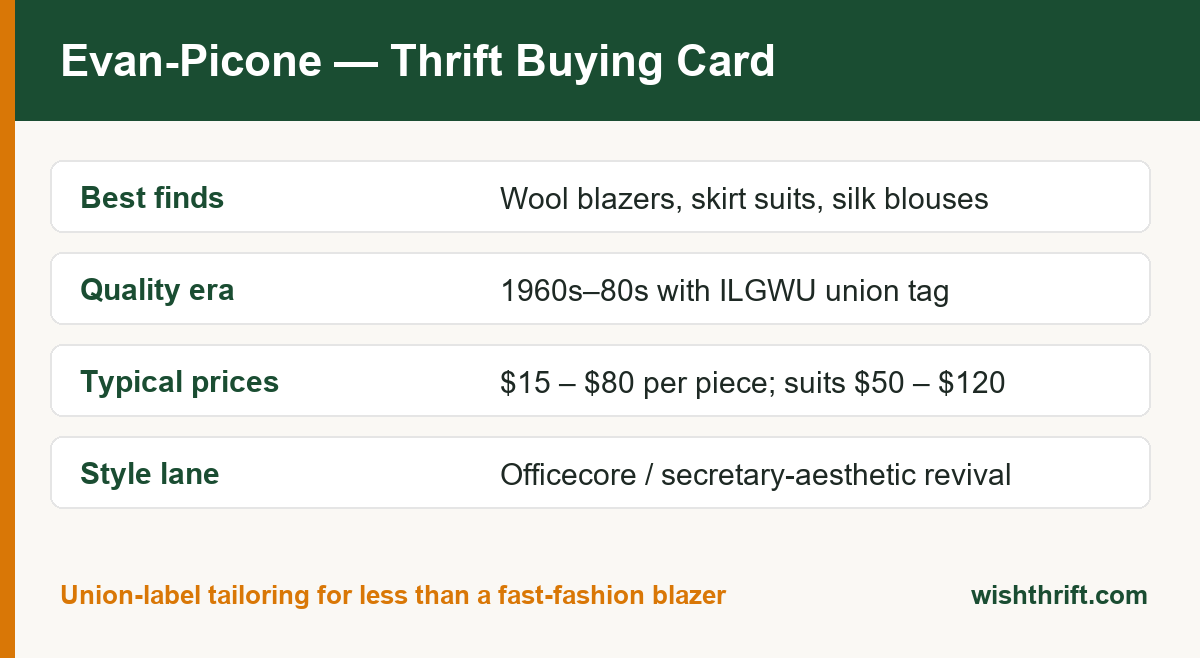
- 2026 prices are modest: $15–$80 per piece, $50–$120 for complete skirt suits — quality far outruns cost.
- Best buys: wool blazers, pencil skirts, silk blouses and two-piece suits in natural fabrics.
The Label, Briefly
Charles Evans and Joseph Picone founded Evan-Picone in 1949 and aimed it at a customer American fashion had underserved: the working woman who needed tailored, durable, genuinely stylish clothes for the office. The brand became a staple of mid-century professional wardrobes — skirt suits, jackets and coordinating separates — and is frequently credited with practical workwear thinking well ahead of its time. Like most heritage American labels it later passed through licensing and department-store eras, which is why dating matters: the name on the tag spans decades of very different quality levels.
Why It Is Being Searched Again
The officecore and secretary-aesthetic trend put the polished professional silhouette — pencil skirt, tucked blouse, structured blazer, kitten heel — back at the centre of vintage fashion. Fast fashion imitates the look; thrift stores contain the original. And because Evan-Picone was produced in volume for decades and donated steadily ever since, supply is genuinely good: the label surfaces constantly at generic-blazer prices, sorted by garment type rather than recognised by name. That gap between cultural demand and rack price is precisely what makes a label worth knowing.
Dating a Piece by Its Labels
Three things date an Evan-Picone garment in under a minute:
- The union tag. An ILGWU label — the International Ladies’ Garment Workers’ Union — places manufacture in the American union era and is the single strongest quality signal on the rack. Union-era Evan-Picone is the tier collectors and dressers actually want.
- The brand label itself. Vintage label styles differ visibly from the modern licensing-era tag; compare typography and layout against verified examples when precision matters.
- Construction. Older pieces show their era: bound or pinked seams, metal zips, structured canvassing in jackets, natural fibres on the content tag. A lined wool blazer with hand-finished details is not a 2000s department-store piece, whatever the tag’s condition.
What to Buy and What to Pay (2026)
| Piece | Typical resale | Notes |
|---|---|---|
| Wool blazers and jackets | $25–$80 | The core buy; union-era structure is the prize |
| Pencil and A-line skirts | $15–$45 | Check waistbands and zips — the common wear points |
| Silk and quality blouses | $15–$50 | Inspect underarms and buttons; silk survivors are undervalued |
| Complete skirt suits | $50–$120 | Matched sets sell best photographed as an outfit |
| Later department-store era pieces | $10–$25 | Fine basics; price and describe as later production |
Bands are directional for mid-2026. This is a value market, not a hype market — prices move slowly, which cuts both ways: no windfalls, but no bubble either.
Fit, Styling and Care
Vintage career wear was cut for a different underpinnings era: waists sit higher, shoulders are structured, and sizing numbers mean nothing — measure shoulders, bust, waist and length, and expect to size up numerically. The styling lane is wide: worn straight it is pure officecore; split up, a structured Evan-Picone blazer over jeans, or a pencil skirt with a band tee, is the high-low mix that dominates current vintage styling — the same logic our downtown girl guide applies from the casual side. Care is simple: dry-clean structured pieces, hand-wash blouses cold, and store wool with cedar.
Why the Quality Argument Actually Holds
It is worth being specific about what union-era construction means, because it is the entire case for the label. Pick up a 70s Evan-Picone blazer and a current fast-fashion equivalent and the differences are physical: the vintage piece has a full or partial lining set in by machine and finished by hand, real interfacing that gives the lapel its roll, pattern-matched seams, generous hems built for alteration, and cloth with enough wool content to press sharp and recover overnight. The modern blazer is fused, skimpily hemmed and pills by spring. That gap exists because mid-century American garment manufacture — union labour, domestic mills, a customer who expected a suit to last a decade — was structurally incapable of making clothes as cheap as today’s. None of this makes Evan-Picone rare or hype-worthy, and the market prices reflect that honestly. It makes it something more useful: a dependable source of construction quality that the price of the rack no longer signals, which is exactly the arbitrage a good thrifter lives on.
Selling Evan-Picone
Name the label and era in your title — buyers now search the brand directly — and photograph the union tag if there is one; it is the picture that justifies your price over the generic-blazer listing next door. Shoot suits as complete outfits on a hanger, state all measurements, and disclose wear at cuffs, lining and zips. Pieces in the tables above are volume items where fees genuinely matter: list free on WishThrift and keep the whole price. For the broader category context, our best vintage brands guide covers the other labels worth pulling from the same racks.
FAQ: Evan-Picone Vintage
What is Evan-Picone?
Evan-Picone is an American womenswear label founded in 1949 by Charles Evans and Joseph Picone that became one of the defining names in women’s career clothing — skirt suits, blazers, blouses and tailored separates for the professional wardrobe. The brand is often credited with practical innovations in women’s workwear, and its mid-century pieces were made to genuinely high standards.
Is vintage Evan-Picone worth anything?
Modestly but reliably. Individual pieces — blazers, skirts, silk blouses — typically sell for $15 to $80 in 2026, with complete skirt suits bringing $50 to $120 and exceptional early pieces somewhat more. The value proposition is quality rather than hype: union-era tailoring in natural fabrics for less than the price of a new fast-fashion blazer.
How do I date Evan-Picone pieces?
The labels are the map. Older pieces carry vintage label styles and frequently an ILGWU union tag — the International Ladies’ Garment Workers’ Union label that places manufacture in the American union era. Fabric content, construction details like bound seams and metal zips, and the silhouette itself all corroborate. Later department-store-era pieces have modern labels and lighter construction.
Why is the secretary aesthetic trending?
Officecore — pencil skirts, tucked blouses, tailored blazers, the polished 60s-to-80s professional look — cycled back as a reaction to years of athleisure, pushed along by film and TV styling. Original career-wear labels like Evan-Picone are the authentic source material, and thrift stores are still full of it at generic prices.
Maya Chen is Senior Editor at WishThrift, where she writes about the global secondhand market, sustainable shopping, and the resale economy. Her work focuses on practical buyer guides — designer authentication, online thrift tactics, used-book hunting, and what to look for on every listing before you pay. She edits the WishThrift seller knowledge base and reviews every guide published on the site.