
No – Ross is not a thrift store. Ross Dress for Less is an off-price retailer: it buys brand-new, unsold merchandise from brands and department stores (overstock, closeouts, cancelled orders) and sells it at 20-60% below regular retail. A thrift store sells donated or secondhand goods, usually far below original retail and often to fund a charity. Both save you money, but they are entirely different shopping models – here is how they compare, and when each one is the better choice.
What Ross actually is: the off-price model
Ross Dress for Less is the largest off-price apparel and home-fashion chain in the United States, with roughly 1,800 stores. Its buyers purchase merchandise the mainstream retail system could not sell at full price: end-of-season overstock, order cancellations, factory overruns and packaway inventory bought cheap and warehoused for the right moment. Because Ross pays brands a fraction of wholesale, it can price new goods 20-60% under department-store retail and still make a margin. That opportunistic buying is also why Ross famously has no online store – the stock is unpredictable by design.
The key word in all of that is new. Nothing at Ross has had a previous owner. The confusion is understandable – cluttered racks, one-off sizes and treasure-hunt energy feel thrifty – but the merchandise itself is the same new product a department store carried, minus the presentation.
What makes a store an actual thrift store
A thrift store sells goods that have already been owned – typically donated (Goodwill, Salvation Army, charity shops) or consigned. Prices are set by the store rather than the brand, usually 70-90% below what the item cost new, and in charity thrift the proceeds fund a mission. The rack is a genuine lottery: decades of styles, discontinued lines, vintage labels and one-of-one finds sitting next to last year’s fast fashion. That is the real dividing line – secondhand stock – and it is also where the sustainability benefit lives, because every thrifted purchase keeps an existing item in use instead of triggering new production.
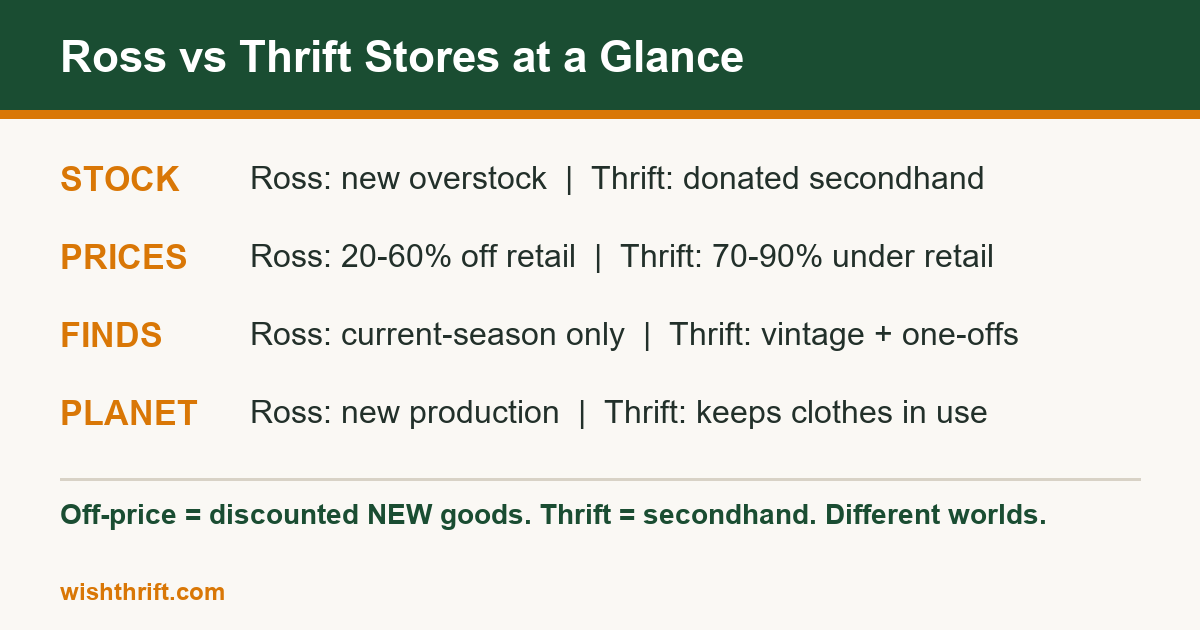
Ross vs thrift stores: side by side
| Ross (off-price) | Thrift store | |
|---|---|---|
| Merchandise | New overstock and closeouts | Donated or secondhand goods |
| Typical discount | 20-60% off retail | 70-90% below original retail |
| Condition | New, often with tags | Used – varies, inspect before buying |
| Selection | Current and recent seasons | Every era – vintage and one-off finds possible |
| Who benefits | Shareholders | Often a charity or local cause |
| Sustainability | Still new production | Extends the life of existing items |
| Returns | Standard return policy | Usually final sale |
Is TJ Maxx a thrift store? Marshalls? Burlington?
No on all counts – they are Ross’s direct competitors in the same off-price category. TJ Maxx, Marshalls, HomeGoods and Sierra all belong to TJX Companies, and Burlington runs the same playbook independently. Every one of them sells new closeout and overstock merchandise. If a store’s stock arrives from brands and distributors rather than from donors and previous owners, it is off-price retail, not thrift – no matter how chaotic the clearance aisle looks.
Outlet malls sit in yet another lane: outlets sell new goods too, but much of it is lower-quality product manufactured specifically for the outlet channel rather than genuine surplus – which is why an outlet “deal” is often a weaker buy than either Ross or a good thrift rack.
Which is actually cheaper?
Per item, thrifting usually wins – and it is not close. A $60 retail shirt might be $30-45 at Ross but $4-8 thrifted. Where Ross earns its place is when you specifically need something new: underwear and socks, a current-season basic in your exact size, or a gift that should arrive with tags on. For nearly everything else – denim, jackets, knitwear, bags, homeware – the thrifted version costs less and has already proven it survives washing. Our guide to the best items to thrift breaks down which categories give secondhand shoppers the biggest edge.
Which is better for the planet?
Thrift, decisively. Off-price retail is a clever way to sell new production that might otherwise be wasted, which is better than landfilling overstock – but it still feeds demand for new manufacturing. Buying secondhand generates no new production at all: the water, dye and energy were spent years ago, and your purchase simply extends the payoff. If the treasure-hunt feeling is what draws you to Ross, thrifting delivers the same dopamine with a better footprint and better prices.
Prefer the thrift side? You do not even need to leave home
The classic knock on thrift stores – digging through crowded racks hoping your size shows up – is exactly what online thrifting fixes. Marketplaces let you search by size, brand and price across thousands of secondhand listings, which no single Ross run or charity shop can match. Start with our online thrift shopping guide, compare platforms in the best online thrift stores roundup, or jump straight into browsing secondhand listings on WishThrift – buying and selling are both free, with no fees on either side.
Why do so many people think Ross is a thrift store?
The confusion is not silly – Ross engineers a shopping experience that feels exactly like thrifting. Racks are dense and loosely sorted, sizes are one-off because stock arrives as remnants, prices are handwritten-low, and finding something great feels like winning rather than buying. Social media blurs it further: “Ross haul” and “thrift haul” videos sit side by side, tagged with the same treasure-hunt language. Even the name plays a part – “Dress for Less” sounds like a charity-shop promise, and the word “thrift” in everyday American English has drifted from meaning secondhand to meaning any bargain hunting at all.
The distinction still matters, though, for three practical reasons. Price expectations: knowing a store is off-price tells you the floor is 20-60% off, not the 90% a thrift rack can hit. Sustainability claims: buying at Ross is discount shopping, not circular fashion – only secondhand keeps existing goods in use. And resale: items bought at off-price stores rarely resell at a profit because everyone had access to the same discount, while genuine thrift finds routinely do – our guide to the best things to resell for profit is built entirely on that gap.
Frequently asked questions
Is Ross Dress for Less a thrift store?
No – it is an off-price retailer selling new overstock and closeout merchandise at 20-60% below retail. Nothing at Ross is donated or secondhand.
Is TJ Maxx or Marshalls a thrift store?
No. Both are TJX-owned off-price chains using the same new-overstock model as Ross, as is Burlington.
Does Ross sell used items?
No – stock may occasionally look shelf-worn from in-store handling, but everything is sourced new from brands and distributors.
Is thrifting cheaper than Ross?
Per item, almost always – thrift runs 70-90% below original retail versus 20-60% off at Ross. Ross is the right call only when the item must be new.
Maya Chen is Senior Editor at WishThrift, where she writes about the global secondhand market, sustainable shopping, and the resale economy. Her work focuses on practical buyer guides — designer authentication, online thrift tactics, used-book hunting, and what to look for on every listing before you pay. She edits the WishThrift seller knowledge base and reviews every guide published on the site.