


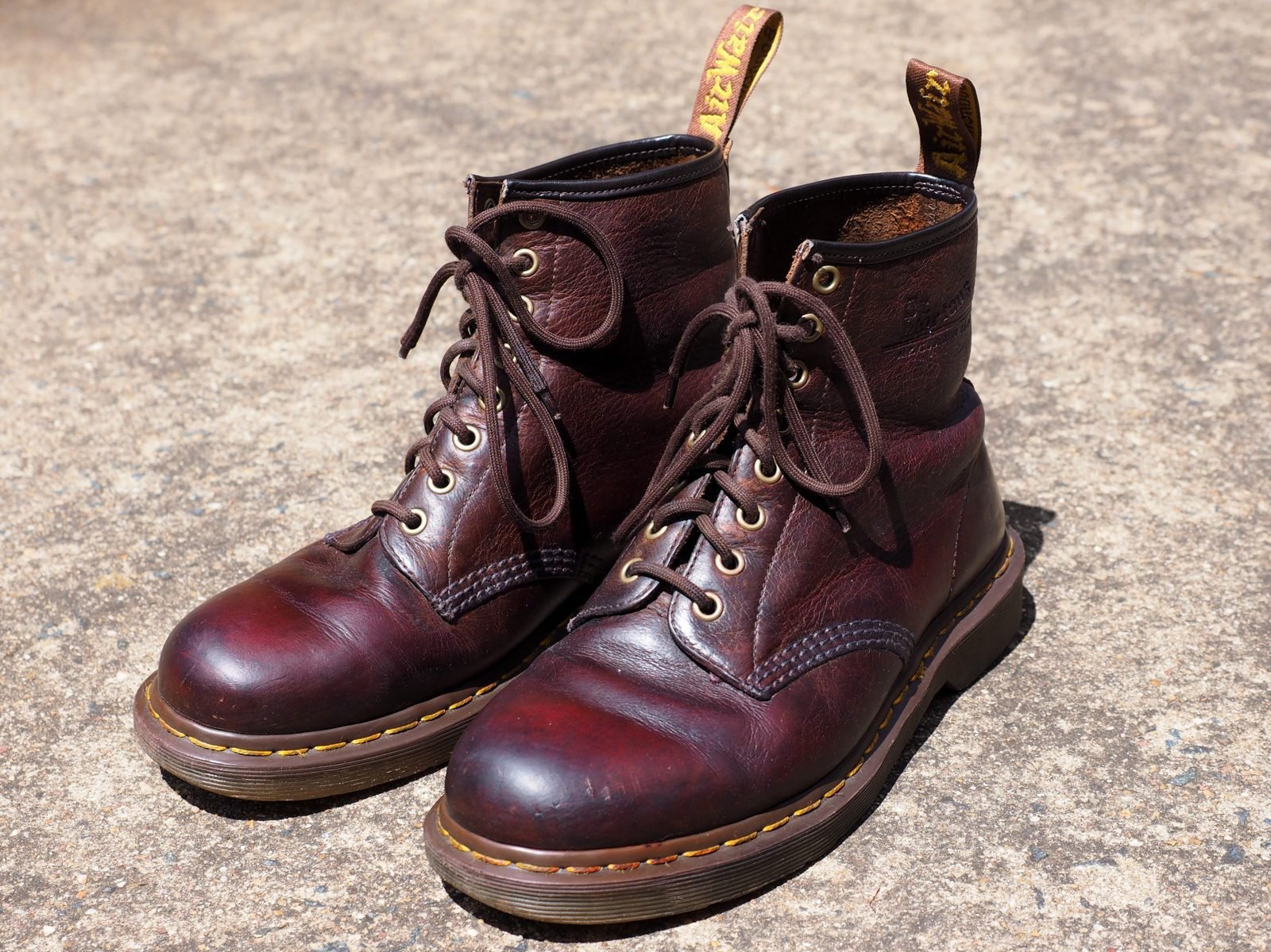
Few shoes survive decades of hard wear and come out more wanted, but that is exactly the deal with Dr. Martens. The 1460 boot has been in continuous production since 1960, the silhouette is permanently in fashion, and the leather genuinely improves with age – which makes thrifted Docs one of the safest secondhand shoe buys there is. The real skill is spotting the Made in England pairs worth several times the ordinary ones. Here is how.
Why used Docs are worth buying
New 1460s cost $170+ and take weeks of blistering break-in. A thrifted pair costs $20-50, is already broken in, and – if it is an older English-made pair – is built from thicker, higher-grade leather than most current production. Docs also carry zero fake risk at thrift prices and clean up dramatically with ten minutes of care, making them ideal resale stock.
Know the models
| Model | What it is |
|---|---|
| 1460 | The original 8-eye boot – the icon, the safest resale |
| 1461 | 3-eye shoe – year-round staple |
| 2976 Chelsea | Elastic-sided boot, strong recent demand |
| Jadon | Chunky platform – huge with younger buyers |
Made in England: the value fork
Since the early 2000s most Docs are made in Asia; the premium “Made in England” (MIE) line continues at the original Northamptonshire factory. Vintage English pairs and current MIE both resell far above standard pairs. Check three places: the heel loop (“AirWair – With Bouncing Soles” in yellow script), the inner size stamp (older English pairs show “Made in England” printed inside), and the sole edge welt stitching in yellow. Softer, slightly wrinkled leather with a broken-in glow is typical of older English pairs; very uniform, stiff, plasticky leather is modern standard production.
Bonus knowledge: until the 1990s the Dr. Martens patent was also worked by English factories associated with Solovair – vintage “Dr. Martens by Solovair” labels are a legitimate collector niche of their own.
Got a pair of Docs sitting in your closet? List it free on WishThrift and keep 100% of the sale – no listing fees, no commission, buyers worldwide.
Condition checks that matter
Soles first: the air-cushioned sole should be intact with visible tread and no splits where sole meets welt – resoling is possible but eats the margin. Leather: creasing is normal and fine; deep cracks through the grain are not. Check the welt stitching for cuts, the eyelets for pulling, and inside for collapsed heel linings. Salt stains, scuffs and dullness all polish out – do not let them scare you off a cheap pair.
Sizing when you thrift
Docs come in whole sizes only and run large – most people size down from their usual, and the fit is roomy with thick socks assumed. Measure the insole length if you are unsure, and remember broken-in vintage pairs have already stretched roughly half a size. For resale, always state the printed size AND insole length in centimetres.
What are used Doc Martens worth?
| Type | Typical resale |
|---|---|
| Vintage Made in England (80s-90s) | $100 to $250+ |
| Current MIE line, used | $80 to $160 |
| Standard modern 1460/Jadon, good shape | $50 to $90 |
| Worn but solid standard pairs | $25 to $50 |
Black and cherry red (oxblood) smooth leather sell fastest. Unusual leathers and collabs can go far higher to the right buyer.
Cleaning up a pair to sell
Ten minutes of work adds real money: brush off dirt, wipe with a damp cloth, treat the leather with balsam or Wonder Balsam-style conditioner, re-lace with fresh laces ($3), and buff. Photograph the heel loop, inner stamp, soles and any flaws. List with model name, printed size and insole length on WishThrift – zero fees, so a $60 pair nets you the full $60. Pair the listing photos with vintage 501s energy – Docs and denim is the eternal combo.
Where to find used Doc Martens
Docs turn up wherever boots get donated: thrift store shoe racks (check every visit – they sell within days), charity shops near universities and art colleges, and end-of-winter donation waves in early spring. Student towns are the best supply because Docs are a first-year purchase that gets abandoned at graduation. Online, search “Dr Martens”, “Doc Martens” AND “DM boots” separately – and look for listings with poor photos and no mention of “Made in England”; sellers who have not checked the stamp price MIE pairs like standard ones. Vintage kilo sales and flea markets surface older English pairs, and car-boot/yard sales remain the cheapest source of all if you are early.
Mistakes to avoid
Skipping the inner stamp – the single most expensive mistake; a “Made in England” mark can triple the value and takes five seconds to check. Buying split soles – separation where sole meets welt means a real repair bill that eats the margin; scuffs polish out, splits do not. Assuming your usual size – Docs run large and whole-sized; buy or list with the insole measurement, not just the printed size. Over-cleaning before sale – stripping the leather with harsh products removes the broken-in character buyers want; conditioner and a buff is enough. And throwing away trashed pairs too fast – even rough MIE vintage pairs sell for parts and restoration projects.
When to buy and when to sell
Docs sell all year but peak twice: back-to-school (September) and the run into winter, when boot searches triple. Supply is heaviest in spring – post-winter clear-outs and graduating students – which makes April-June the cheapest months to buy and September-December the best months to sell. Cherry red and black 1460s clear fastest in autumn; sandals-season is when you will find them cheapest and least contested. Made-in-England pairs are the exception to all seasonality: collectors buy them whenever they surface, so list those immediately at full price. For everything else, a pair bought for $25 in May and listed clean and conditioned in mid-September is the textbook Docs flip.
Got a pair of boots you never wear sitting in your closet? List it free on WishThrift and keep 100% of the sale – no listing fees, no commission, buyers worldwide.
FAQ
How do I know if Doc Martens are Made in England?
Check the inner size stamp for ‘Made in England’, the yellow ‘AirWair – With Bouncing Soles’ heel loop, and the yellow welt stitching. Older English pairs have softer, slightly wrinkled leather compared with the stiffer uniform leather of modern standard production. MIE pairs resell for roughly double standard pairs.
Are used Doc Martens worth buying?
Yes – they are already broken in (the hardest part of owning Docs), the leather improves with age, and condition problems that matter (split soles, cracked leather) are easy to spot. Scuffs, salt stains and dullness all polish out with conditioner.
What size Doc Martens should I thrift?
Docs come in whole sizes only and run large – most people wear a size down from their usual US size. Broken-in pairs have stretched about half a size more. Measure the insole in centimetres if unsure, and state that measurement when selling.
How much do used Doc Martens sell for?
Standard modern 1460s in good shape bring $50-90, current Made-in-England pairs $80-160, and vintage 80s-90s English pairs $100-250+. Black and oxblood smooth leather sell fastest.
Explore more thrifting guides or list your item free.
Maya Chen is Senior Editor at WishThrift, where she writes about the global secondhand market, sustainable shopping, and the resale economy. Her work focuses on practical buyer guides — designer authentication, online thrift tactics, used-book hunting, and what to look for on every listing before you pay. She edits the WishThrift seller knowledge base and reviews every guide published on the site.