



A Jean Paul Gaultier dress can be a $100 diffusion find or a four-figure runway grail, and the difference is written on the label inside it. Gaultier’s archive — above all the mesh dresses with their trompe-l’oeil and tattoo prints — became one of the most wanted vintage categories of the 2020s, helped by celebrity styling and the house’s own reissues of its classics. Those reissues are also the trap: original-era money for recent production is the most common mistake in this market. This guide decodes the label hierarchy, dates the mesh, and prices every tier for 2026.
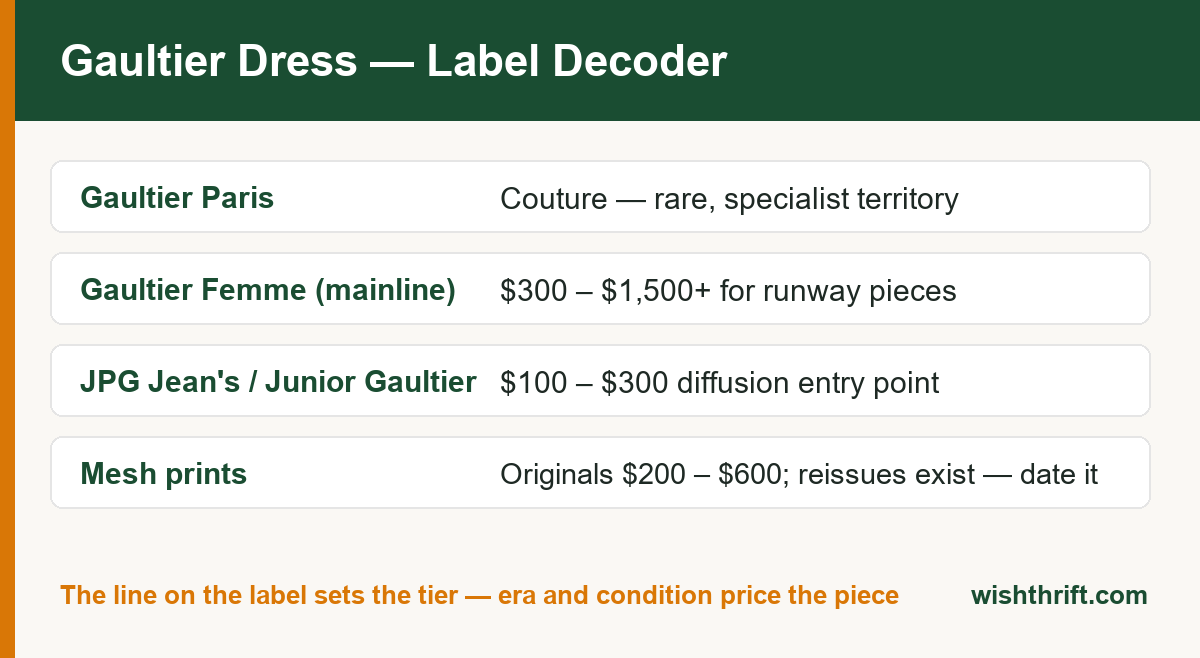
- Read the label first: Gaultier Paris (couture) > Gaultier Femme (mainline) > JPG Jean’s / Junior Gaultier (diffusion).
- Typical 2026 prices: diffusion $100–$300, mainline $300–$1,500+, verified original mesh $200–$600.
- The famous mesh prints have modern reissues — genuine Gaultier, but not vintage; date before paying archive prices.
- Condition rules are unusual: mesh tolerates wear badly, and alterations hurt runway pieces most.
Why Gaultier Is Having a Permanent Moment
Jean Paul Gaultier spent four decades as French fashion’s great provocateur — the sailor stripes, the cone bra, the tattoo-print mesh that put body art on bodies that had none. He showed his final couture collection in January 2020, and the house pivoted to celebrating its own archive: guest designers, collaborations, and reissues of the most famous pieces. Meanwhile stylists put archive Gaultier on a generation of celebrities, and the mesh dresses became a red-carpet and social-media fixture. Founder retired, archive canonised, demand global: the textbook conditions for a vintage market running hot.
The Label Hierarchy, Decoded
Every Gaultier price conversation starts with which line the piece belongs to:
- Gaultier Paris — the couture line. Rare, largely auction territory, and outside everyday resale.
- Gaultier Femme / Gaultier Homme — the mainline ready-to-wear where the significant runway pieces live. This is the collector tier.
- JPG Jean’s Paul Gaultier and Junior Gaultier — the 90s diffusion lines: wittier, cheaper, produced in volume. Today they are the accessible entry into authentic Gaultier, and rising.
- Soleil and speciality lines — home of many signature mesh pieces; the line most affected by modern reissues.
Label layouts and typography changed across eras, which is your dating tool: compare the tag against verified period examples before accepting any listing’s decade claim. Missing or cut labels on a supposed mainline piece should price it down sharply — the label is a third of what you are buying.
The Mesh Question: Original or Reissue
The tattoo- and print-mesh dresses are the most searched Gaultier items, and the house has reissued the classics in recent years. Reissues are genuine, well-made and desirable — but they are current production, priced accordingly at retail, and they should trade below verified originals. Separate them by the label format (period-correct versus current), construction details and fabric hand compared against verified examples, and the seller’s provenance story. A dress with a current-era label is a reissue no matter how iconic the print; pay reissue money. When a listing’s photos won’t settle it, the method in our fake designer guide applies unchanged: label macro, construction quality, provenance questions, price logic.
What Gaultier Dresses Sell For (2026)
| Tier | Typical resale | Notes |
|---|---|---|
| JPG Jean’s / Junior Gaultier dresses | $100–$300 | The entry point; witty 90s diffusion, rising steadily |
| Mainline Gaultier Femme | $300–$1,500+ | Significant runway pieces exceed the band on their own market |
| Verified original mesh pieces | $200–$600 | Print, era and condition set the exact number |
| Modern reissue mesh | Under original-era prices | Genuine Gaultier, current production — price as such |
| Damaged or altered pieces | Heavily discounted | Mesh runs and alterations hurt this label more than most |
Bands are directional for mid-2026. This market has a long tail of exceptional pieces — anything that might be runway-significant deserves a search of recent auction and sold results before either side commits.
Where Gaultier Still Hides
The runway pieces are picked over, but the diffusion lines are not — and that is where the realistic finds live. JPG Jean’s and Junior Gaultier were produced in genuine volume through the 90s and sold worldwide, so pieces still surface in general vintage shops, European secondhand markets and, occasionally, ordinary thrift stores whose sorters see an unfamiliar label rather than a famous one. Search listings the way uninformed sellers write them: misspellings like Gaultier without the u, or just JPG, return mispriced pieces that the correctly spelled searches never show. Knitwear, mesh tops and tailoring from the diffusion lines are the most commonly missed items, because without a dramatic print they read as ordinary clothes until the label is checked. The habit that pays is the same one that works for every archive label: know the tag formats cold, check anything vaguely French and witty, and move quickly when a diffusion piece is priced as a regular dress — at $30, the downside is a good dress and the upside is a $250 flip.
Condition, Care and Selling
Gaultier punishes condition problems unusually hard. Mesh laddering is often irreparable; prints must not be cracked or faded; and alterations that would be routine on ordinary vintage destroy value on runway pieces, where the original cut is the point. Store mesh flat, wash cold by hand or dry-clean per label, and keep prints out of sunlight. Selling, photograph the label before anything else, then the print, the seams and every flaw; title with the line and era (JPG Jean’s Paul Gaultier 90s, Gaultier Femme mesh); and state measurements precisely — 90s Gaultier cuts run small. High-value pieces are exactly where zero fees matter most: on a $500 dress, typical platform commission takes $50–$100, while listing free on WishThrift leaves the full price with you. Our selling designer clothes guide covers the trust-building that gets four-figure vintage sold to strangers.
FAQ: Jean Paul Gaultier Dresses
How much is a vintage Jean Paul Gaultier dress worth?
By line and era: diffusion pieces from JPG Jean’s and Junior Gaultier typically bring $100 to $300, mainline Gaultier Femme dresses $300 to $1,500 and beyond for significant runway pieces, and the celebrated mesh prints roughly $200 to $600 for verified originals. Couture is specialist-auction territory. Prices are directional for 2026 — notable pieces move on their own market.
What are the different Jean Paul Gaultier labels?
A hierarchy: Gaultier Paris is couture; Gaultier Femme (and Homme) is the mainline ready-to-wear; JPG Jean’s Paul Gaultier and Junior Gaultier are the more accessible diffusion lines from the 90s; and lines like Soleil carried signature pieces including the famous mesh. The label inside the garment is the first and most important fact about any Gaultier piece.
Are the Gaultier mesh dresses being reissued?
Yes — the brand has re-released its celebrated mesh and print pieces in recent years, and they sell heavily. Reissues are genuine Gaultier and desirable in their own right, but they are not vintage: date the label and construction before paying original-era prices, because listings blur the line constantly.
Is Jean Paul Gaultier still designing?
Gaultier stepped back from the runway after his January 2020 couture show, and the house has since continued through collaborations and guest couturiers while reissuing archive designs. That combination — no new mainline from the founder, constant celebration of the archive — is exactly what pushed secondhand demand for original pieces upward.
Maya Chen is Senior Editor at WishThrift, where she writes about the global secondhand market, sustainable shopping, and the resale economy. Her work focuses on practical buyer guides — designer authentication, online thrift tactics, used-book hunting, and what to look for on every listing before you pay. She edits the WishThrift seller knowledge base and reviews every guide published on the site.