


The vintage glass worth grabbing at a thrift store comes down to six names: uranium glass (it glows bright green under UV light), jadeite, carnival glass, pre-1986 patterned Pyrex, Murano art glass and marked cut crystal. All six routinely sit on shelves priced $2-10 and resell for $30-300+, because thrift stores price glass by size, not by what it is. The whole game is identification – and you can run every test that matters in the aisle with a $15 UV torch, your phone light and thirty seconds per piece.
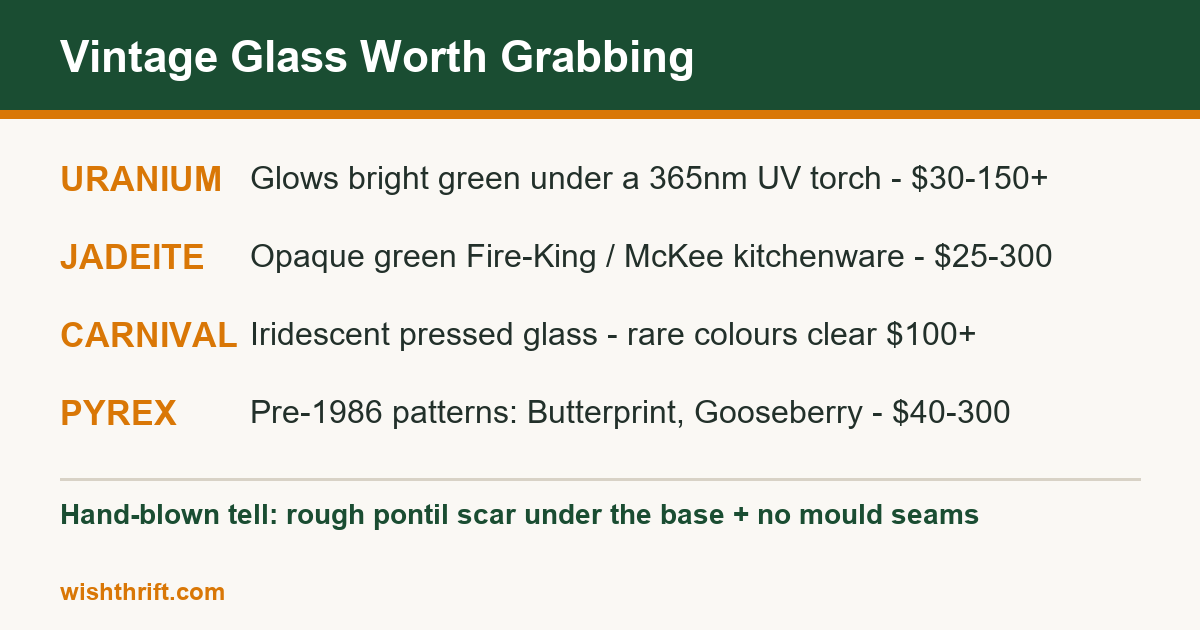
- Uranium glass fluoresces bright green under a 365 nm UV torch; thrifted for pocket change, it typically resells for $30-150+.
- Jadeite by Fire-King, McKee or Jeannette runs $25-300 depending on the piece; unmarked lookalikes are worth far less.
- Carnival glass in marigold is common – the money is in rare colours like red and aqua opalescent.
- Pyrex value lives in pre-1986 patterns (Butterprint, Gooseberry, Snowflake); a dulled dishwasher finish can halve it.
- Hand-blown tell: a pontil scar under the base and no mould seams.
- Reproductions exist for nearly every category – fine random base wear is the age check fakes usually fail.
Which vintage glass is actually worth money at a thrift store?
Here is the shelf-scanner’s shortlist, with the ten-second tell for each and honest resale ranges. Prices assume undamaged pieces – a single chip typically cuts value by half or more, so run a fingertip around every rim before you commit.
| Glass type | 10-second tell | Typical thrift price | Typical resale |
|---|---|---|---|
| Uranium / vaseline glass | Bright green glow under 365 nm UV; yellow-green daylight tint | $2-10 | $30-150+ |
| Jadeite (Fire-King, McKee, Jeannette) | Opaque milky green; check base for maker embossing | $1-8 | $25-300 |
| Carnival glass | Metallic rainbow sheen on pressed glass | $3-12 | $20-100; rare colours $100+ |
| Vintage Pyrex opalware | Colour/pattern on white glass, pre-1986 backstamp | $3-15 | $40-300 for wanted patterns |
| Murano / Italian art glass | Vivid layered colour (sommerso), controlled bubbles, pontil scar | $4-15 | $50-250+ |
| Cut lead crystal (Waterford etc.) | Acid-etched base mark; long clear ring when flicked | $3-20 | $40-200 for marked pieces |
| Depression glass | Thin pressed colour (pink/green/amber), light wear | $1-6 | $5-40; rare patterns higher |
| Milk glass | Opaque white, hobnail texture common | $1-5 | $5-30 – collect it, do not flip it |
The 60-second aisle scan: how to test glass on the spot
Serious glass thrifters run the same four-step routine on every promising piece, and none of it needs a lab:
- Flip it. The base is where glass tells the truth: maker marks (embossed anchors, script signatures, acid etches), a pontil scar for hand-blown work, and – crucially – wear. Decades of shelf life leave a haze of fine, random scratches. A pristine base on a “vintage” piece, or neat parallel sanding marks, means reproduction.
- Light it. Sweep your 365 nm UV torch across the shelf with the lights low if you can. Uranium glass answers instantly with a radioactive-green blaze nothing else matches. (Some pre-1930 clear glass glows soft peach from manganese – a nice age clue, but not the jackpot.)
- Flick it. Rest the piece on your fingertips and flick the rim. Lead crystal sings – a clear ring that hangs for a second or more. Ordinary soda-lime glass gives a dull tick. This is how you find unmarked Waterford hiding among the wine glasses.
- Seam it. Run a finger up the sides. Mould seams mean pressed, mass-produced glass; their absence plus a pontil scar means hand work, and hand work is where Murano-level money lives.
What does the UV torch actually tell you?
Uranium glass contains a small amount of uranium dioxide added as a colourant, mostly between the 1880s and the early 1940s, when wartime uranium restrictions ended the practice. Under ultraviolet light the uranium fluoresces vivid green – the single most reliable identification test in all of glass collecting. Buy a 365 nm torch rather than a cheap 395 nm one: the shorter wavelength produces a cleaner, brighter response with far less purple wash. And to answer the question everyone asks: yes, uranium glass is safe to own and display. The radioactivity is trace-level; collectors simply do not use heavily worn pieces for storing food or drink, which is an easy rule to live with.
Which Pyrex patterns should you grab?
Vintage Pyrex opalware (1947-1986) is the most liquid glass category online – buyers actively hunt specific patterns to complete sets. Grab anything in Butterprint (Amish farmer print), Gooseberry (especially pink), Snowflake, and any short-run promotional piece you do not recognise, because the obscure ones are often the valuable ones. Solid-colour primary bowls sell steadily too as complete sets. The condition rule is brutal and simple: the finish must be glossy. Dishwasher detergent permanently dulls the colour, and collectors call those pieces DWD – expect them to fetch half or less.
How do you avoid reproductions?
Every valuable category above has been reproduced – depression glass since the 1970s, jadeite lookalikes by the pallet, new “uranium-style” glass that also glows. Your defences: base wear (fine and random = age; absent or uniform = new), colour (repros often run brighter and more saturated than originals), weight and seams (many repros are heavier, with seams in places the originals never had them), and marks (Fenton marked its glass from the 1970s onward – an unmarked “old Fenton” piece needs to earn your trust on shape and wear alone). When in doubt at $4, buy it anyway – the education is cheap and the downside is a nice vase.
Keep the value you just found
Hand wash only, in warm – never hot – water; thermal shock kills old glass, and dishwashers kill both gilding and Pyrex gloss. Cloudy “sick glass” from decades of hard water sometimes clears with a white-vinegar soak, but etched cloudiness is permanent, so factor it into what you pay. Store carnival glass out of direct sun to preserve the iridescence, and never stack jadeite without padding – the rims chip, and chips are half your money gone.
Where to sell vintage glass finds
Glass rewards sellers who identify precisely: “Uranium glass footed candy dish, glows under UV, no chips” outsells “green vintage dish” many times over. Photograph the base mark, the glow shot where relevant, and the rim condition. Then list where the fees do not eat the margin – on WishThrift both listing and selling are free, so a $60 jadeite bowl pays you $60. Browse the art and collectibles and kitchen categories to see what glass is moving, check our thrift finds worth a fortune roundup for the headline stories, and if you are building a sourcing habit, the thrift-flip playbook covers the business end. Silver shelf next? Read the companion guide to thrift store silver plating finds.
Frequently asked questions
Which vintage glass is worth money at thrift stores?
Uranium glass, jadeite, carnival glass in rare colours, pre-1986 Pyrex patterns, Murano art glass and marked cut crystal – all common at thrift prices, all with real resale markets.
How can you tell if glass is uranium glass?
A 365 nm UV torch: true uranium glass glows unmistakable bright green. Daylight clue: a yellow-green vaseline tint.
Is vintage Pyrex really valuable?
Wanted pre-1986 patterns in glossy condition sell from about $40 to several hundred dollars; dishwasher-dulled pieces fetch half or less.
How do you spot hand-blown glass?
Pontil scar under the base, no mould seams, and genuine random base wear from age.
Maya Chen is Senior Editor at WishThrift, where she writes about the global secondhand market, sustainable shopping, and the resale economy. Her work focuses on practical buyer guides — designer authentication, online thrift tactics, used-book hunting, and what to look for on every listing before you pay. She edits the WishThrift seller knowledge base and reviews every guide published on the site.
1 thought on “Thrift Store Vintage Glass Finds: What to Grab & What It’s Worth (2026)”
Comments are closed.