
Most silver-plated flatware at a thrift store resells for very little – but the silver shelf still hides real money, in exactly three places: luxury-maker plate (Christofle, WMF, genuine old Sheffield plate), unusual Victorian hollowware, and above all solid sterling mis-shelved as plate, because busy pricing staff read shine, not hallmarks. Learn six marks – 925, Sterling, the lion passant, EPNS, EP and A1 – and you can clear an entire silver bin in about two minutes, buying only what actually pays.
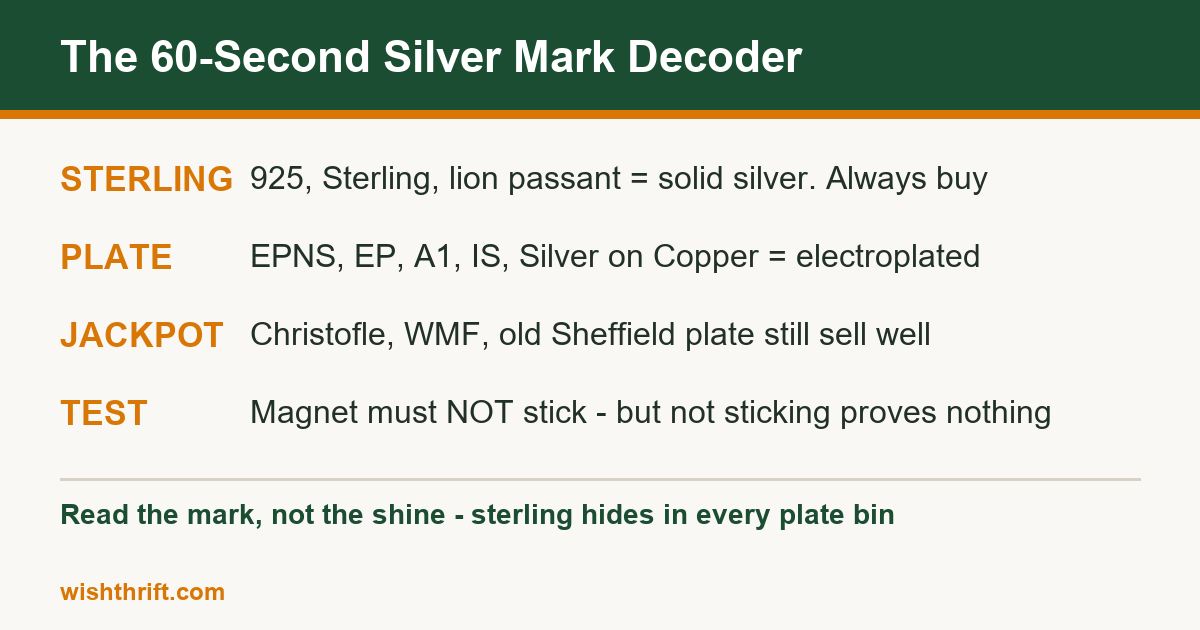
- EPNS, EP, A1, IS and “Silver on Copper” all mean electroplated – a microns-thin silver skin with no melt value.
- 925, “Sterling” or a British lion passant hallmark means solid silver – buy it every time at thrift prices.
- Christofle is the exception among plate: the French maker’s pieces sell for $50-300+ secondhand despite being plated.
- A magnet only rules silver out; plated copper and nickel pass the magnet test too.
- Warm pink “copper bleed” at handles, rims and high points is the visual signature of worn plate.
- Never machine-buff or aggressively dip old silver – gentle cream polish preserves both plate and value.
Is thrifted silver plate worth anything, honestly?
Here is the truth most listicles dodge: the silver layer on plated ware is measured in microns, so there is no scrap value at all. When plate sells, it sells as objects – for the maker’s name, the design, or the completeness of a set. That means the bin sorts into a clear hierarchy:
| Find | Marks / tells | Typical resale |
|---|---|---|
| Christofle (French luxury plate) | “Christofle”, trademark punches | $50-300+ per piece; flatware sets far more |
| WMF Art Nouveau pieces | “WMF” in a diamond or ostrich mark | $80-400 for period hollowware |
| Genuine old Sheffield plate (pre-1850) | Fused silver-on-copper, seams visible, no EPNS mark | $100-500+ – collected in its own right |
| Victorian figural pieces (napkin rings, cruets) | Quadruple plate marks, sculptural forms | $40-200 |
| Big-name American tea sets (Gorham, Reed & Barton, International) | Maker mark + pattern number | $60-250 per set |
| Complete boxed flatware sets | Full service, fitted chest | $40-150 |
| Loose plated flatware | EPNS / A1 / IS singles | $1-2 a piece – leave it, or buy for craft use |
Note the trap hiding in that table: a modern spoon stamped “Sheffield England EPNS” is ordinary electroplate that happens to come from Sheffield. Genuine old Sheffield plate is the earlier fused process – sheets of silver heat-bonded to copper before electroplating existed – and it carries no EPNS mark at all. The words are nearly identical; the values are not.
How do you tell sterling from plate in the aisle?
Work the marks first, the metal second. Flip every piece and hunt the stamps, usually on the underside of flatware handles, the base rim of hollowware, or inside teapot lids:
- Solid silver: “925”, “Sterling”, “Ster”, a British lion passant (walking lion) hallmark, or continental fineness numbers “800” / “830”. Any of these at a thrift price: buy.
- Plate: “EPNS”, “EP”, “EPBM”, “A1”, “AA”, “IS”, “Silver on Copper”, “Quadruple Plate”. Value now depends entirely on maker and form per the table above.
- No mark at all: usually plate or nickel alloy – but unmarked continental and colonial silver exists, so let the secondary tells vote.
Then confirm with the metal itself. Copper bleed – a warm pink glow at handle edges, feet and embossing high points – is worn plate announcing itself. Sterling tarnishes grey-to-black but never shows pink. The magnet test is widely misquoted: if a magnet sticks, the base is steel and the piece is certainly not solid silver, but if it does not stick you have learned almost nothing, because copper, brass and nickel silver bases are non-magnetic too. Magnet = veto power only.
What do EPNS, A1 and IS actually mean?
Decoding the alphabet soup, since these four cause the most confusion: EPNS is electroplated nickel silver – a nickel-copper-zinc alloy (containing no silver itself) coated with a thin electroplated silver layer. EP is the generic electroplate abbreviation, and EPBM is the same idea over Britannia metal. A1 and AA are not quality boasts but plating-thickness grades from the manufacturer. IS on American pieces usually means International Silver Company, a plate giant – not “is silver”. And Victorian “Quadruple Plate” meant four times a standard silver deposit, which still amounts to a coating thinner than a human hair.
The real jackpot: sterling hiding in the plate bin
This is the habit that separates profitable silver thrifters from browsers: check every single piece, because thrift stores shelve by shine. Grey, tarnished sterling looks worse than gleaming plate, so the valuable spoon is routinely the ugly one. Singles count – even one sterling teaspoon carries $10-40 of intrinsic value, and full sterling serving pieces go much higher. Two caveats keep you honest: weighted sterling candlesticks and trumpet vases are marked sterling but filled with cement for stability, so the actual silver content is modest – always describe them as “weighted” when selling. And continental “800” silver is genuinely solid, just a slightly lower fineness than sterling – still a buy at thrift prices.
Should you polish your finds – and is replating worth it?
Polish less than instinct tells you. Light tarnish lifts with a mild silver cream and a soft cloth; aggressive chemical dips and buffing wheels strip micro-detail, and on worn plate they can cut straight through to base metal, destroying what value existed. The popular foil-and-baking-soda bath is fine occasionally on solid silver but risky as a habit on old plate. On antiques, many collectors actively prefer soft, honest patina – sell the object, not the mirror. As for replating: professional re-silvering typically costs more than the finished piece will fetch, so it only ever makes sense for sentimental restoration, not for resale.
Where to sell silver finds
Honesty is the strategy, because buyers of silver read marks too. Describe plate as plate – “Christofle silver-plated serving tray” is a strong listing; “silver tray” that turns out to be EPNS is a return. Photograph every hallmark in macro, show the copper bleed if it exists, and price by maker and form. Then keep the margin: listing and selling on WishThrift are both free, so browse home and garden and kitchen to gauge the market, and if a piece turns out to be sterling jewellery, our selling jewellery online guide covers that lane. Sourcing systematically? The best things to resell for profit ranks silver against every other category, and the companion piece on thrift store vintage glass finds covers the shelf one aisle over.
Frequently asked questions
Is thrift store silver plate worth anything?
Plain plated flatware, very little. Maker plate (Christofle, WMF), old Sheffield plate, Victorian figural pieces and complete sets sell well – and mis-shelved sterling is the real prize.
How do you tell sterling from silver plate?
Marks: 925/Sterling/lion passant = solid; EPNS/EP/A1/IS = plate. Pink copper bleed at wear points confirms plate. A magnet can only rule silver out.
What does EPNS mean?
Electroplated nickel silver: a nickel alloy body with a microns-thin electroplated silver coating. No solid silver content.
Should you polish thrifted silver?
Gently, with silver cream – never dips or buffing wheels. Worn plate polishes through, and collectors often pay more for honest patina than for a stripped shine.
Maya Chen is Senior Editor at WishThrift, where she writes about the global secondhand market, sustainable shopping, and the resale economy. Her work focuses on practical buyer guides — designer authentication, online thrift tactics, used-book hunting, and what to look for on every listing before you pay. She edits the WishThrift seller knowledge base and reviews every guide published on the site.
1 thought on “Thrift Store Silver Plating Finds: Plate vs Sterling Value Guide (2026)”
Comments are closed.